



Aula Leopoldina will always be number one
Conversation with Professor Jan Harasimowicz, the Museum of the University of Wrocław director
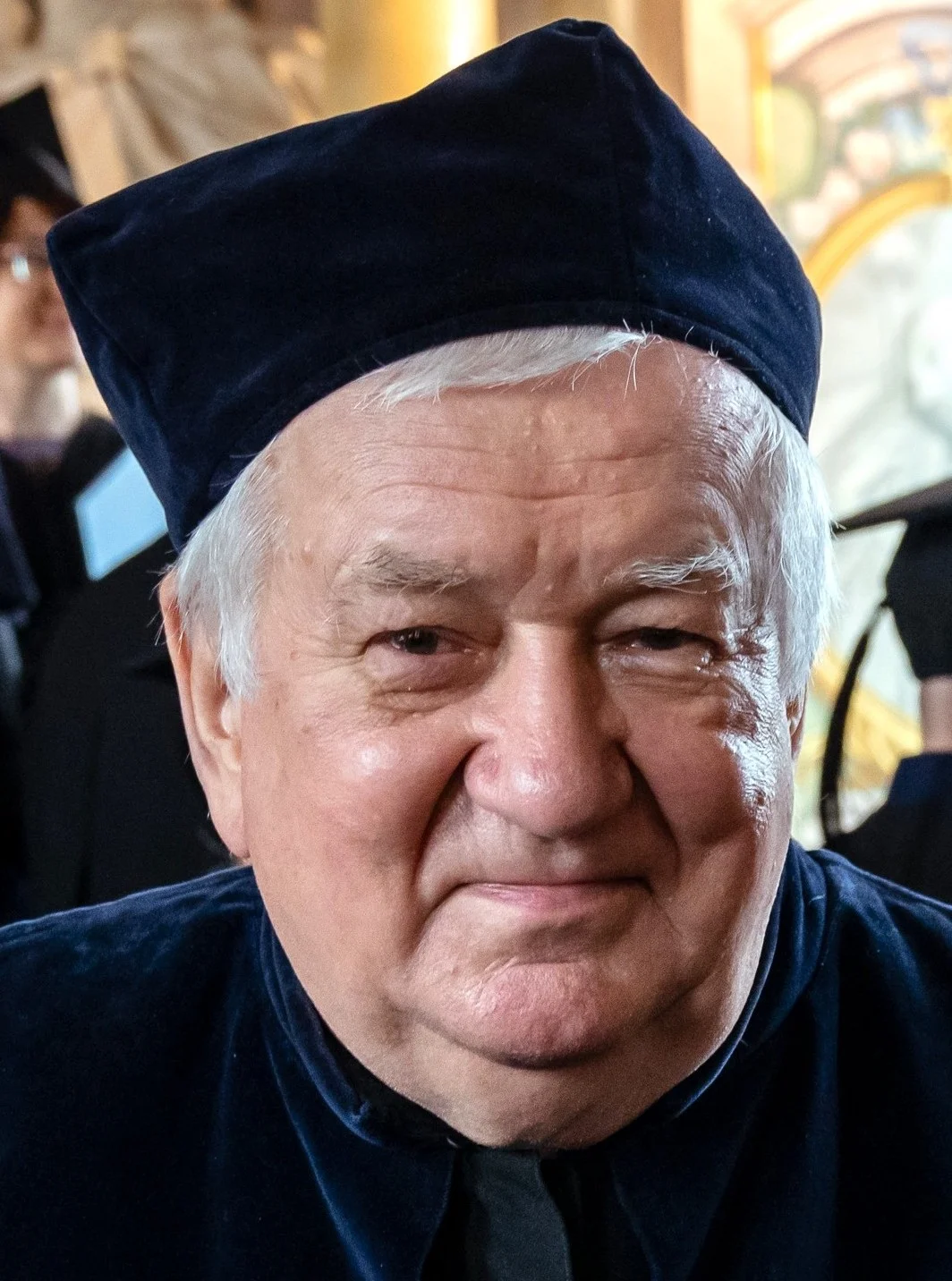
Such jubilees are right for giving us faith, uplift, and showing that in science, we really count. Have a sense that we did something valuable and sensible, and that this way we are giving each other the benefit of doubt for the future. With Professor Jan Harasimowicz, art and culture historian, Jacek Antczak talks.
You were the science editor and one of the authors of the monumental Encyklopedia Wrocławia. How many terms concern our university and researchers from the University of Wrocław? Wrocław, like any other Polish city, is 80 years old, similarly to our Alma Mater. What significance, then, does the University have for Wrocław? How much space does it take in Encyklopedia?
Prof. Jan Harasimowicz: I haven’t checked, but matters, people, buildings of the University of Wrocław is surely one fourth of the Encyklopedia Wrocławia. Of course, if we look at everything that is connected with the University holistically. Because when we look at the University of Wrocław, then obviously at first view we see buildings, a lot of excellent ones. And it already is a fair amount of the University in Wrocław’s history. Forty historic facilities belong to the University of Wrocław, but after all, every beautiful, new building is worth mentioning. That is why, on our jubilee exhibition, we were boasting about the Library of the University of Wrocław, the Student Houses Kredka and Ołówek, and even Dwudziestolatka, which was a very modern dormitory when it was established.
80 years of the Polish University of Wrocław, but apart from monuments from centuries before, or just before 1945, there are also many not always historic, but even iconic facilities. However, the University is primarily the university’s science and people, and students.
Yes, historic buildings and modern ones, then the university’s museums and their content. It is also a fair capital, but most of all it is a huge number of scholars, who were there from the beginning, from the Leopoldine Academy (1702). That is, they were professors at a Jesuit university. Specific figures have fallen into oblivion, and nobody mentions them. For instance, Longinus Anton Jungnitz, we all remember – the founder of the astronomical observatory, who appointed easting and because of that, Wrocław’s meridian, we have a memory of him. He was yet a Jesuit, who switched to public service. Later, we have many excellent professors from the Prussian public university (1811-1945). There are a lot of famous scholars, because the University often was the first workplace for many people who later hardened their fame somewhere else. For example, the first Wrocław’s Nobel Prize winner, who was awarded in 1902 for monumental Historia Rzymu (The History of Rome), Theodor (Thomas) Mommsen, was a law professor at the university from 1854 to 1858. Most of the book about Rome was written in Wrocław, although everybody associates him with Berlin. It was like that with many superior scholars – there was their first stint, and then they hardened their science standing somewhere else. The same situation was in all departments. We have remarkable representatives of medical sciences, or theology, especially evangelical theology, who were working there for decades.
Then 1945 comes…
…and after that censorship, Polish scholars also emerged, trained in their original universities, especially in Lviv. I will always underline the role of our first president, Stanisław Kulczyński. He was an extremely right person and he had huge experience. After all, he was chosen for Lviv University’s president and in 1938, in protest against the law and anti-Jewish ghetto benches, he established an office. He said that, as president, he will not implement the higher education law because it doesn’t align with his beliefs. And exactly those people, such as him and his staff, created our Polish university. They were immediately very well prepared for what they were supposed to do. With wonder, I learned how people such as Władysław Czapliński, Kazimierz Maleczyński, and many others were shaping our university. They knew exactly what and how they had to do, because they just knew “how to do the university”.
They also knew how to “do the science” in a foreign city and region.
They knew. Let’s take my field – from the beginning, they knew how to study the history of Silesia because they had been doing it before the war. We have to remember that Wrocław luckily lies in Silesia. However, Poland regained earlier a part of Silesia and during the interwar period, Silesian Institute in Chorzów did a great job. Other Polish universities, especially Kraków and Lviv, carried out study activities on Silesia too. It was said that “we regained a piece, and we want more”. Concededly, it wasn’t about Wrocław, but people were wondering if it would be possible to shift the borders to Opole. The whole time those studies on Silesia were carried out. At the end of the 40s, we had a mass of publications at the University of Wrocław. Then a huge Silesian history project began, later, in the 60s, huge volumes in yellow, linen covers were appearing. Similarly as before, already at the Polish University of Wrocław, many scholars succeeded in science.
From all fields – hard sciences and humanities.
From all fields. I remember such university icons, which I had the occasion to observe myself. Such as Bogusława Jeżowska-Trzebiatowska, a chemist, founder of the power of the university’s chemistry, or Professor Bronisława Morawiecka, who was establishing biochemistry there. Or superior lawyers, we have a whole circle of scholars at the Faculty of Law, Administration and Economy. After all, Professor Witold Świda was working there, a lawyer from Vilnius, who was the president at the turn of 50s and 60s. And what about mathematicians? Hugo Steinhaus, Edward Marczewski, Czesław Ryll-Nardzewski, Kazimierz Urbanik and others from Wrocław’s mathematicians school. Superior people. And even „genius”, as Mateusz Urbanik wrote in the book about Lviv’s mathematicians, some of them were later in Wrocław. After all, they created Wrocław’s mathematics school at the University of Wrocław and Wrocław University of Science and Technology. That is why it was a huge pride studying at our university because there were people who were absolute authority figures. I, for example, had two such superior teachers: Professor Mieczysław Zlat, who was handling Renaissance, and Professor Zygmunt Świechowski, who was a medievalist and, in 1963-1978, was an executive of the Institute of Art’s History. Professor Świechowski, when I was a student, published two books in France and was known and cited all over the world. It was like that from the beginning in many fields. We can list many great Polish students, philologists, and Germanists. Personally, I had the pleasure of knowing Professor Jan Wrabc, the most remarkable Baroque connoisseur, from Lviv.
And when it comes to the Enlightenment, let’s mention my master too, Professor Stanisław Pietraszka, the founder of cultural studies.
I remember that blue book, which I read from cover to cover, with his comments and translation. That canonic book by Jean Hazard – Kryzys świadomości europejskiej (The Crisis of European Awareness). Then Stanisław Pietraszko found cultural studies…
Earlier, at philology, he wrote canonic Doktryna literacka polskiego klasycyzmu. It is also worth mentioning his successor, Stefan Bednarek, and in philology, Jerzy Woronczak…
Those figures were many. Professor Mieczysław Klimowicz, who was the president, a remarkable Enlightenment connoisseur, Professor Czesław Hernas, a Baroque specialist, and Professor Jacek Kolbuszewski, also an excellent Polish language researcher. Some of those figures, which I am enumerating, we will present at our exterior exhibition, organised for the 80th anniversary of the University of Wrocław, which will be opened on the 1st of October at the market square.
Were there any problems with that?
There were some problems because there were many masters. However, we socialised exhibition development and the whole academic community was engaged. I know that at some of the institutes, there was even voting at the institute’s council for who from the masters should represent their institute. I will sincerely admit that we purposely did like that, and the president confirmed it. Our idea was to make the university feel its jubilee. Such jubilees are right for giving us faith, uplift, and showing that in science, we really count. Have a sense that we did something valuable and sensible, and that this way we are giving each other the benefit of doubt for the future. We show that we’re moving in the right direction, and we can do even more. Those jubilees are for that; for example, the 80th anniversary of the University of Wrocław is not just a celebration.
We have the year 2025. When I read your biography, I noticed that it is also your lively jubilee because you are working at the University of Wrocław since 1975, that is for 50 years. Half of the century – it is a long time. And since 2010, that is for 15 years, you are an executive of the Museum of the University of Wrocław.
Yes, it is just the 50th year of my science work going on. My master’s thesis was announced in 1975, and then my first scientific publication appeared, which was dedicated to the main pile. Actually, it was a revival of Henryk Dziurla’s book Uniwersytet Wrocławski, published in 1975 by Ossolineum. That review was titled Patrimonium scientia, that is, „Supervision over science” because it contains the idea of our Aula Leopoldina.
And it stayed with you. For 50 years, you have been taking care of science, the aula, the heritage of the University of Wrocław.
Yes, of course, my research concerns not only Wrocław and Silesia, but also the whole of Europe. Project, which is consummating with a huge publication in that year, is a result of a multimillion grant from the National Science Centre: Protestant church building of the modern epoch in Europe, which embraces almost the whole of Europe, where reform left some marks, from Serbia to the Island.
In Encyklopedia Wrocławia, which you edited and which already has three editions, you cover the whole topic. Do you have that approach for a story about the University of Wrocław? Holistic?
It is my plan, but it began already in 2010, when I became the executor of the Museum of the University of Wrocław. President Marek Bojarski proposed that I take the leadership of Komitet Obchodów Dwustulecia Universytetu in 2011, and I said, “Agree, president, but maybe we would create a solid museum of our university for that occasion”. There was actually none. After all, the ground floor performed other functions, and our most beautiful exhibition hall was a warehouse. Nothing was there. Earlier, there was a student club Indeks, but it was in the old days. I said president that it may be a beautiful museum there. „We will also renovate Wieża Matematyczna, in a while, the reconstruction of the frescos in Oratorium Marianum will be finished, and we will have a beautiful museum.” And we did that. We also found a huge conference “Uniwersytet Wrocławski w kulturze europejskiej” (‘The University of Wrocław in European culture’), and we wanted to publish the Jubilee Book in four volumes – two appeared. Content from the third volume concerns exactly the pre-war history.
So they are there…
… and on that basis, what we already have, those volumes, which were published and the contents, which we gathered, we are able to describe the ages of that first university and create a holistic popular science history of the University of Wrocław.
You said „we”. Will you write it?
I could. When I finish my mission leading the museum, I hope the president will commission me to write that book about the university, including its buildings, affiliated institutions (that is, museums), and so on… That whole university’s presentation in its multileveled activity, also with the attempt to estimate input in science in general. For the rest, I already took that attempt. I gave the inauguration lecture for the opening of the academic jubilee year 2011/2012. Then I challenged the myth that our University wasn’t important, peripheral, that old German university, and later our Polish university. Such an opinion has been formed about our university, but it is not true; it is a myth.
I will come back to the museum for a while because you mentioned that before the museum, there was a student club, Indeks. Did you play the clarinet during your studies?
I did, I did, but it wasn’t at Indeks and not during the studies. It was earlier, we had the rock and roll band in the 5th High School in Wrocław. I played on the clarinet, but I was also a conference speaker and a vocal singer. The band’s name was Czerwone Tarcze. And in the past, when Wrocław’s president, and later Bogdan Zdrojewski, culture minister, arrived with Seweryn Krajewski, I was guiding them around the University of Wrocław, and I admitted: “Mr Seweryn, we were modelling ourselves on you a little bit, on the Czerwone Gitary…”. It was in 1967, during my pre-matura exam. Ryszard Klisowski was our instructor and later superior composer, and he was delivering us original, published in Great Britain, the Beatles’ pieces, so we didn’t have to write them down from the radio. We had notes, and on the studies, I even led my own club and cabaret. The club was at ul. Szewska 36 and it was named „Progres”. And there with my friend psychology student Zygmunt Mucha, we had a two-person cabaret Persyflaż.
You guided many people from the world of culture and politics at the University of Wrocław, what makes the biggest impression on them?
Aula for sure, restored to full brightness. Aula will always be our number one, but also Oratorium Marianum, Mathematical Tower, and they also like expositions in the Hall under the Pillar. It is amazing that the Museum of the University of Wrocław is an active functioning object. In the Jagiellonian University Museum, there is a separate whole; there are no classes. But here the University is alive, it is working all the time, here the everyday life of our Alma Mater goes on, and there sightseers are climbing up the tower. We do not even have any museum halls because, for instance, if somebody wants to organise a concert in the Oratorium, they have to address the main pile. And sometimes it happens like that, as on the Long Night of Museums. Somebody rented Aula Leopoldina, and there was a problem. We had to open the entrance, so the people from the Long Night of Museums didn’t mix with those who came for the concert.
The conversation was carried out by Jacek Antczak.
The interview with Prof. Harasimowicz appeared in the nr 2/2025 of Przegląd Universytecki.
Translated by Maja Filar (student of English Studies at the University of Wrocław) as part of the translation practice.
Date of publication: 26.11.2025
Added by: J.A.


