




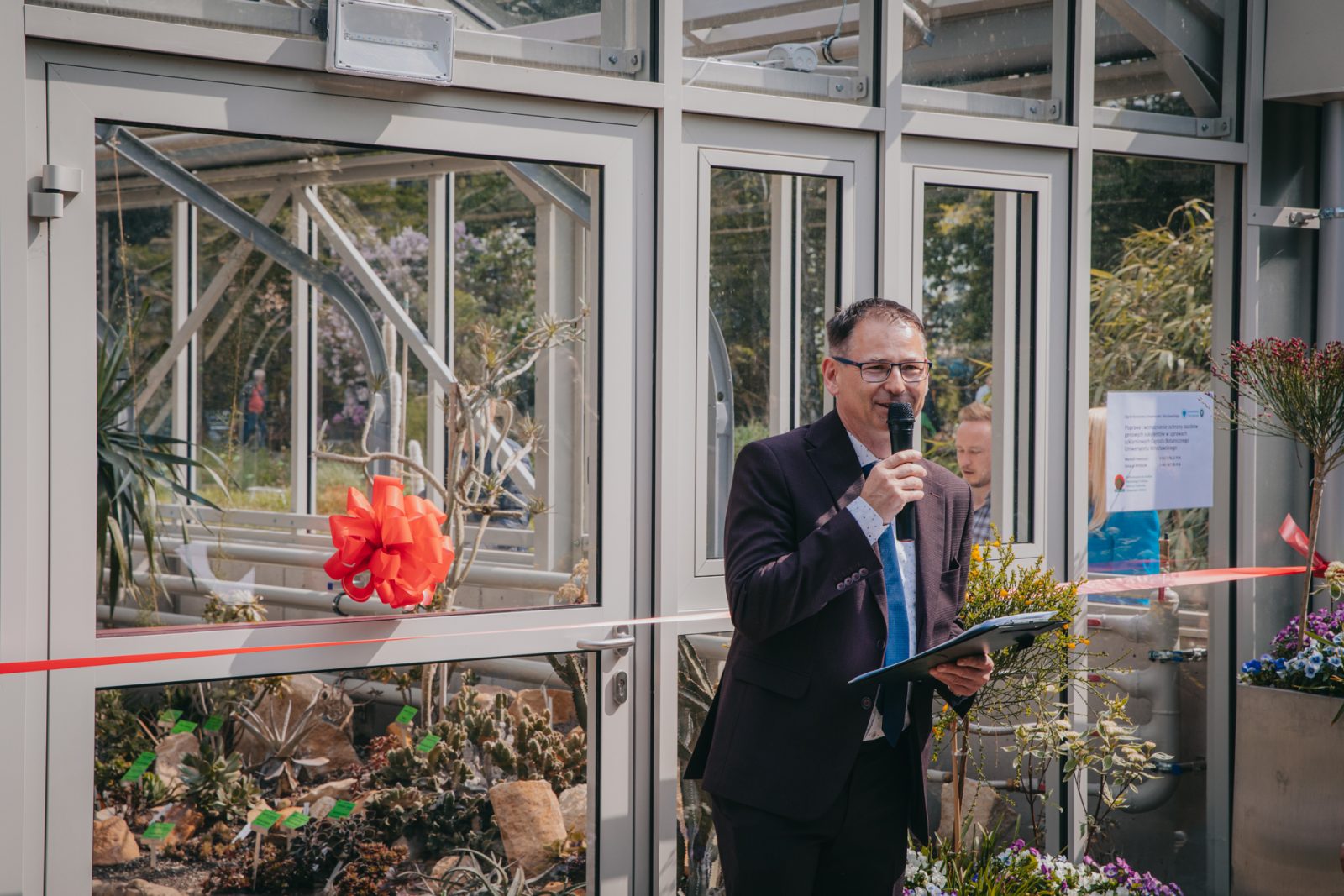
Director of the Botanical Garden of the University of Wrocław among 50 important people in Polish Ecology in 2025
Ekologia.pl has published a ranking of 50 important people in Polish ecology. At the top of the list are the most notable scientists with a lifetime experience in research – climatologists, ecologists, hydrobiologists, foresters, and naturalists, whose work has been setting standards for environmental discourse in Poland. In the top ten is dr hab. Zygmunt Kącki, prof. UWr, Director of the Botanical Garden.
The ranking indicates who substantively influences the direction of changes through scientific research, nature preservation, education, and system activity. High in the ranking are also people connected with environmental foundations and organisations who, in 2025, conducted positive, measurable initiatives: from preserving rivers and forests, through air quality, and food security, to climate law and social education.
In 2025, in the face of the increasing climate crisis, degradation of biodiversity, and accelerated frictions around energy transformation, the significance of green authorities rises. Hence, an attempt to answer the question, who really shapes contemporary Polish ecology- scientists, activists, experts, or policymakers?
– I treat this distinction as a congenial signal that the pro-environmental efforts are acknowledged and appreciated – comments dr hab. Zygmunt Kącki, prof. UWr – The year 2025 has shown that there is no single answer to the question of the most influential person in Polish ecology. Scientists and experts, as well as policymakers, the law and its executing system, but also the everyday choices of society. We all must care for the environment; this is our home, which cannot defend itself. Botany and sciences remind us about the basic truth – without plants, as the source of primordial matter, and efficiently functioning ecosystems, we will not survive as a species. Therefore, we have to preserve nature in all its complexity and diversity, and not only as a resource, but primarily as the condition of the existence of life, which we are part of.
The rapport considered the following criteria:
– impact on green politics: people contributing to the introduction of new laws, regulations, or strategies of preserving the environment,
– implementation of ecological projects: leaders of initiatives that positively impacted the condition of the environment, for example, landscape revitalisation, protection of diversity, or development of renewable energy sources,
– education and social awareness: people actively participating in information campaigns, courses, or educational publications concerning ecology,
– scientific research: scientists who published valuable research on environmental protection or climate change,
– ecological innovation: creators of new technologies, products, or solutions fostering sustainable development,
– international cooperation: people who gained international recognition by cooperating with European organisations in nature protection,
– long-term commitment: active members consistently working for ecology, and whose actions have measurable effects.
More information on the website.
We remind you that “Winter Weekends” at the Botanical Garden start on January 10-11 and will continue until March 1, 2026. The Garden is open on Saturday and Sunday from 9:30 a.m. to 5 p.m. (last entrance at 4:30 p.m.). The entrance is from ul. Świętokrzyska (next to the gatehouse).
Edited by Katarzyna Górowicz-Maćkiewicz
Translated by Natalia Kupis (student of English Studies at the University of Wrocław) as part of the translation practice.
Date of publication: 9.01.2026
Added by: M.K.


