



Polish–Ukrainian cooperation at the University of Wrocław
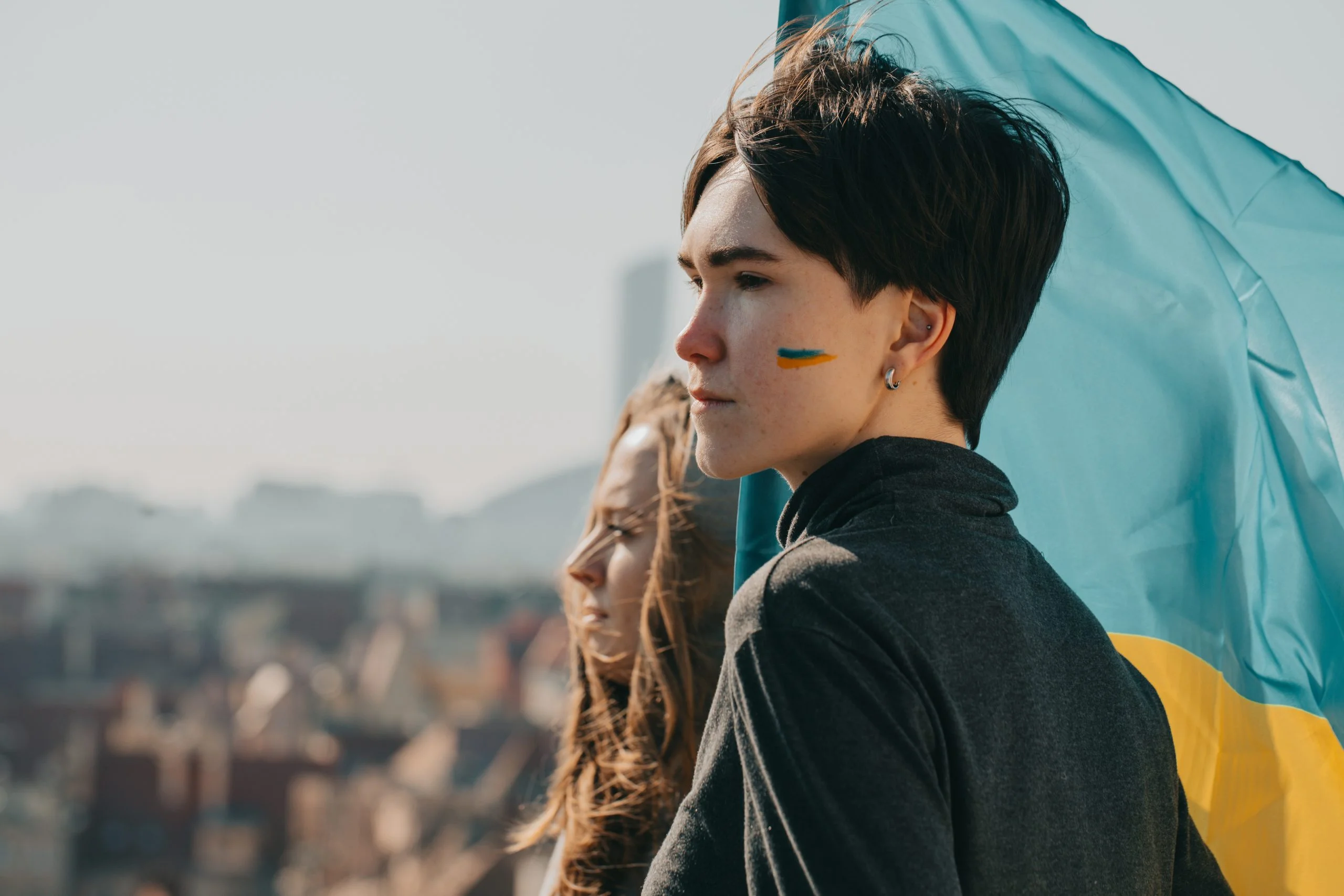
At the beginning of 2026, the University of Wrocław strengthened its commitment to developing Polish–Ukrainian relations. Pursuant to Rector’s Ordinance No. 232/2025, the Wrocław University Center for Polish-Ukrainian Cooperation was established – a new university-wide unit whose mission is to develop academic and research cooperation with Ukraine, strengthen the position of UWr as a leading centre for Ukrainian studies, and support the rebuilding of the teaching potential of Ukrainian higher education institutions. We talk about the Center’s first activities with its Director, prof. dr hab. Agnieszka Matusiak-Bakuła.
Maria Kozan: What expectations accompany the launch of the Center for Polish-Ukrainian Cooperation, and what concrete activities and initiatives will be undertaken in its first months of operation?
Prof. Agnieszka Matusiak-Bakuła: The Center was established to strengthen, in a synergistic way, what has been taking place at the University of Wrocław for many decades: multifaceted academic cooperation with Ukrainian partners. However, the Center locates its mission not only within the sphere of research. Responding to the challenges of our time, it seeks to operate at the intersection of science, education and society, so that knowledge and research become real tools for building Polish–Ukrainian dialogue, while at the same time serving as a significant development impulse for the academic community of UWr, the city of Wrocław and the Lower Silesia region.
For this reason, in the first months of its activity the Center will focus on five interrelated priorities.
First, consolidating around the Center a permanent forum for cooperation with Polish and Ukrainian universities, which may form a basis for building research networks and consortia facilitating joint applications for national and international funding (e.g. research, innovation and educational projects).
Second, the synergistic integration of UWr’s potential. For many years, almost every faculty of our University has maintained active links with partners in Ukraine. The Center’s intention is to map, connect and strengthen these relationships in order to fully utilise the potential of the humanities and social sciences, law, management and economics, as well as the natural and exact sciences.
Third, reflection on possible projects, academic exchange programmes, internships and mentoring schemes for students and early-career researchers from Poland and Ukraine, aimed at building durable competence bridges between academic communities.
Fourth, initiating activities for social dialogue and cooperation with the wider environment. I believe that the Center should actively cooperate with the city authorities, local government, business and non-governmental organisations to demonstrate that science is a key partner in the region’s social and economic development; that science cannot remain isolated, because its meaning emerges in dialogue with practice.
Finally – and above all – the organisation of the international interdisciplinary conference “The Future Is Already Here. Poland–Ukraine–Europe: A New Paradigm”, which will officially inaugurate the Center’s activities in May this year and, in its concept, integrates all four of the priorities outlined above.
MK: Who forms the Center’s team and what research perspectives and academic experience do its members contribute?
AMB: The team brings together people with extensive experience of cooperation with Ukraine and international partners, capable of operating within the “science–local government–business–civil society” framework. This makes it possible to undertake coherent initiatives rooted in real needs.
First and foremost, I must acknowledge those without whom the Center would not exist: the Rector of the University of Wrocław, prof. Robert Olkiewicz – the initiator and patron of the Centre, who successfully secured ministerial funding for this much-needed initiative – and prof. Jarosław Syrnyk, the Rector’s Representative for cooperation with Ukraine, who integrated the university community around the idea of the Center, involving not only academic staff but also students. This led, in 2024, to the establishment of the Community of Ukrainian Students and Academics.
As regards the Programme Board, which also includes prof. Jarosław Syrnyk, I invited: dr hab. Barbara Kowalczyk, Vice-Dean for Education at the Faculty of Law, Administration and Economics; dr hab. Mateusz Świetlicki, prof. UWr, Vice-Dean for Student Affairs and Part-Time Studies at the Faculty of Languages, Literatures and Cultures; and dr hab. Larysa Leshchenko, prof. UWr, Head of the Department of Eastern Studies at the Institute of International Relations and Security. The Board is chaired, in accordance with the Center’s regulations, by the Vice-Rector for Internationalisation, dr hab. Patrycja Matusz, prof. UWr.
The Center thus forms an interdisciplinary team combining different languages of description: literary studies, cultural studies, history, social sciences, political science and international law. This intersection of perspectives is our strength, enabling us to design comprehensive and long-term initiatives from geopolitical and transformation analyses to educational and social projects.
MK: The international interdisciplinary conference “The Future Is Already Here. Poland–Ukraine–Europe: A New Paradigm”, to be held in Wrocław on 20–22 May 2026, will officially inaugurate the Center’s activities. What does the conference theme mean to you and what will be the main areas of debate?
AMB: The slogan reminds us that profound changes in security, education, culture, the economy, technology and mentality are happening here and now. We cannot think about Ukraine’s reconstruction or Europe’s security in terms of a distant future; this is a process that requires engagement today, by everyone.
The debate will therefore focus on, among others: cross-border legal cooperation; human rights protection and the rule of law; new forms of activism and transnational solidarity; a new paradigm of regional security and agency; education and the rebuilding of university potential; culture, memory and decolonisation; media, communication and disinformation; the economy of reconstruction and cooperation with business; and technologies and the exact sciences in the service of rebuilding. A separate conference track will be devoted to students and doctoral candidates.
MK: Is registration for the conference still open, and what should applicants pay attention to?
AMB: Yes, the call for papers and participant registration is open until 31 January. Submissions should include a proposed paper or panel title, an abstract (200–300 words) and a short biographical note (up to 80 words). We particularly welcome proposals combining academic knowledge with practical experience. The conference will be held in person. Papers may be delivered in Polish, Ukrainian or English; plenary sessions will be simultaneously interpreted. The conference fee is PLN 450 for domestic participants and EUR 100 for international participants; for students and doctoral candidates: PLN 300 and EUR 75 respectively.
MK: How does the Center intend to use Wrocław’s unique potential as a Polish–Ukrainian meeting point?
AMB: The presence of a large Ukrainian community, a strong academic environment, active cultural institutions and a dynamic business sector creates a natural ecosystem conducive to cooperation. We intend to act in three dimensions: academic and research, socio-cultural, and business-oriented, integrating dispersed initiatives into a coherent strategy and fostering pilot and implementation projects.
MK: The Center for Polish-Ukrainian Cooperation is not only gaining its mission, but also a specific space on the map of the University of Wrocław. In the future, it will be located in the very centre of the city, at ul. Kuźnicza 29b, sharing space with the Institute of Musicology of the Faculty of Historical and Pedagogical Sciences. Where can you currently contact the Center and what is the best way to establish cooperation with it?
AMB: Until the permanent headquarters are launched, we operate at the Institute of Slavic Studies of the Faculty of Languages, Literatures and Cultures at ul. Pocztowa 9. A dedicated website will soon be launched with full contact details. Contact is also possible via my university email address.
MK: Finally, what would you wish for the Center in the coming year?
AMB: Above all, that the Center becomes an effective partner in cooperation between the West, Poland and Ukraine, demonstrating the role of science in rebuilding institutions and communities. I hope we will translate energy and goodwill into concrete outcomes: joint projects, publications and durable networks of cooperation, proving that “the future is already here” is not a slogan, but a commitment.
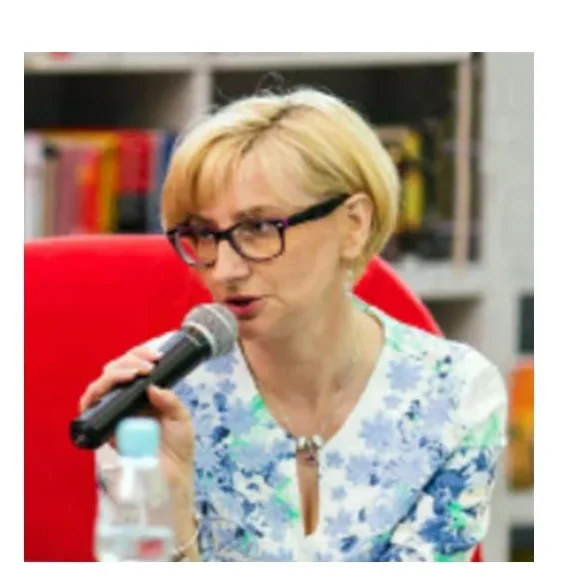
Agnieszka Matusiak-Bakuła – professor of Humanities, literary scholar and Slavist. Since 1998 she has worked at the Institute of Slavic Studies of the University of Wrocław. From 2008 to 2018 she headed the Department of Ukrainian Studies. From 2015 to 2026 she has directed the Centre for Transcultural Post-Totalitarian Studies. A former Harvard University fellow and recipient of the Gloger Award. Her research interests include Russian and Ukrainian literature and culture, memory and trauma studies, postcolonial and decolonial thought, Jewish history and culture in Ukraine, and comparative studies of Global East theatre.
_____
We have written more about the university building of the Wrocław University Center for Polish-Ukrainian Cooperation, which is currently under construction, in the following posts:
Date of publication: 13.01.2026
Added by: M.K.


