




Making Pre-War UWr dissertations accessible in the BUWr online catalogue
In 2024, the University Library (BUWr) received funding of PLN 33,579.00 for the project: “Upowszechnienie przedwojennych dysertacji Uniwersytetu Wrocławskiego w katalogu online BUWr.” This project was funded by the Ministry of Science and Higher Education under the programme „Social Responsibility of Science II – Support for Scientific Libraries.” The comprehensive retrospective computer processing of selected items was conducted by the staff of the Silesian-Lusatian Documentation Department. The project ran from December 2, 2024, to March 1, 2026.
The University of Wrocław was founded in 1811 by the union of the Catholic Leopoldine Academy (established in 1702) and the Protestant Viadrina (established in 1506 in Frankfurt an der Oder). Initially known as the Königliche Universität zu Breslau (Universitas Litterarum Wratislaviensis), it was renamed the Schlesische Friedrich-Wilhelms-Universität zu Breslau in 1911. The institution operated continuously until January 1945. The first doctoral defenses took place in 1812, and the final ones in 1944. During World War II, when printing was difficult, dissertations were also submitted as A4-format typescripts.
The pre-war doctoral and habilitation dissertations in the BUWr collection originate primarily (though not exclusively) from two sources: the preserved holdings of the Königliche und Universitätsbibliothek and the Stadtbibliothek (City Library). Dissertations from the former City Library were originally intended to form part of the Wratislaviana collection – a pre-war collection of prints concerning Wrocław, organized by subject and marked with call numbers beginning with the letters Ya, Yb, Yc. Doctoral theses served as a supplement to the heading „University of Wrocław,” receiving the call number Yu. Heinrich Wendt, in his Katalog der Druckschriften über die Stadt Breslau (1903) and its Nachtrag (1915), did not include them because a separate catalogue was planned, which, however, was ultimately never created.
After the war, the dissertations were integrated into the general collections of the University Library, except for materials focused on Silesian-Lusatian history. These specific items, now part of the Silesian-Lusatian collection, were the focus of this project.
Three hundred document titles were selected for retrospective electronic processing. The selection criterion was the absence of a bibliographic record in the electronic catalogue of the National Library (since 2024, BUWr has cooperated with the National Library within a shared cataloguing environment). Each newly created record received a complete set of descriptors and detailed copy descriptions. It was also necessary to establish authority files for the author, as 99% of them did not previously have personal entries in the National Library.
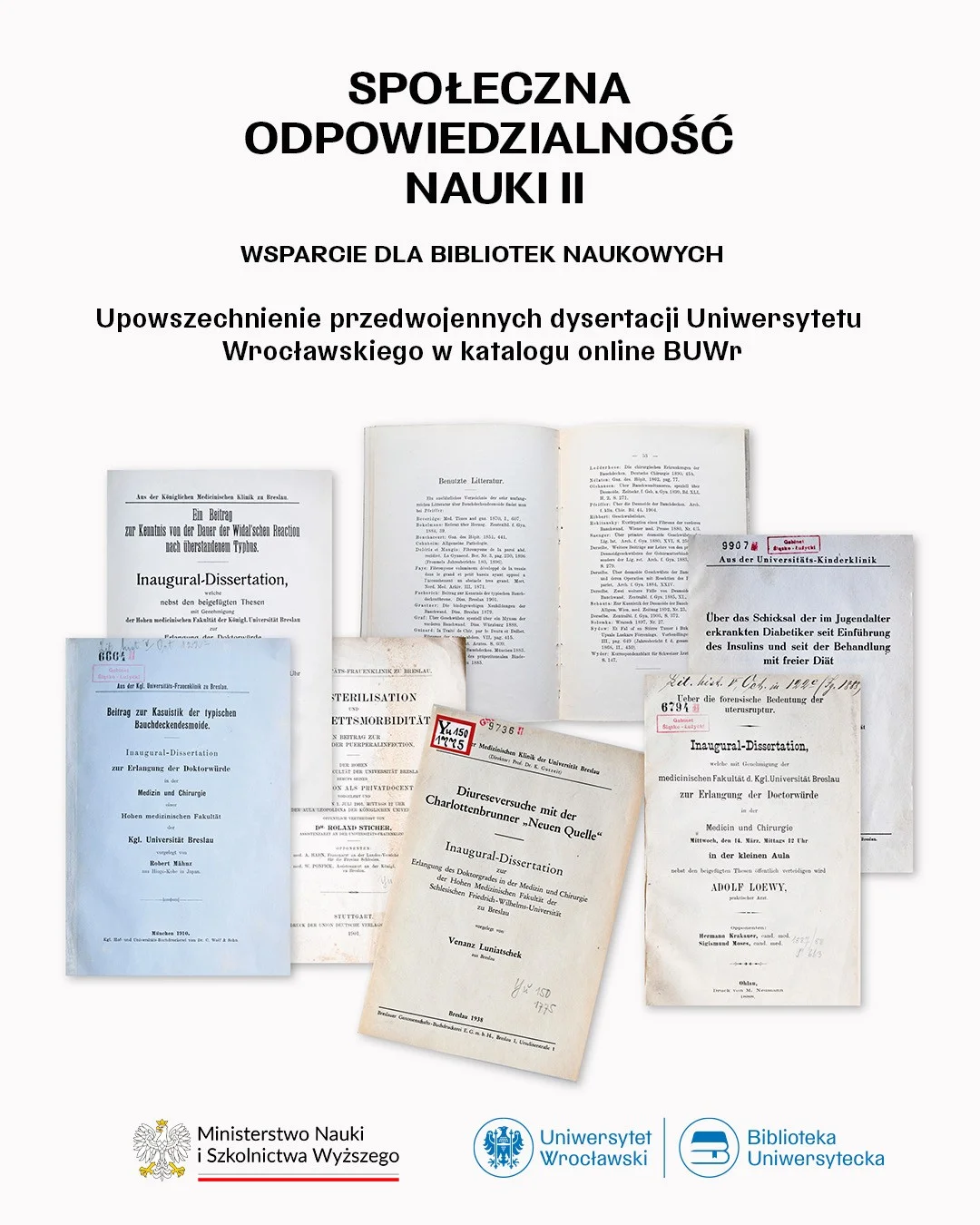
The University of Wrocław dissertations form a unified, formally standardized collection. Each copy is typically a small booklet, often without a cover. A mandatory condition for defense was the prior publication of the work in print, either as a standalone edition or within a scientific journal.
Offprints presented for the dissertation defence were equipped with an additional title page. They differed from the book version only in paging, retaining the original page numbering from the journal. Title pages often also included the date and time of the defense, as well as the names of the supervisor, reviewers, or the dean of the faculty.
A unique feature of this collection is the inclusion of the author’s biography on the final or penultimate page. These biographies contain valuable data, such as date and place of birth, parents’ names, the father’s occupation, religion, and educational background. This information serves as a vital source for research into the social and geographical origins of scholars of that era.
In the group of 300 dissertations (spanning 1831-1941), works in the fields of medicine dominate, followed by law and art history. Nearly 70% of the authors were from historical Silesia, mainly from the area of today’s Lower Silesia, but also from Greater Poland and various regions of Germany. While German was the primary language of the dissertations, some works were written in Latin. Out of the 300 authors, only 17 were women – reflecting the era’s realities, as women were only permitted to attend lectures from the mid-1890s. The first woman to earn a doctorate at the University of Wrocław was Clara Immerwahr in 1900.
More than 70% of the dissertations were printed in Wrocław. Most often, the services of the Breslauer Genossenschaftsbuchdruckerei (founded in 1870) were used, while earlier works were produced, among others, in the printing houses of the Korns or Robert Lucas. Although Fraktur (blackletter) remained popular until the beginning of the 20th century, it was used in only seven cases.
Pre-war dissertations are a valuable source of material for scientists, historians, and everyone interested in the intellectual culture of the region. The project has expanded the library’s knowledge base, making these works available in both national and international bibliographic and scientific circles.
Translated by Hanna Jordanek (student of English Studies at the University of Wrocław) as part of the translation practice.
Author: Katarzyna Grodecka, Silesian-Lusatian Documentation Department, Library of the University of Wrocław
Publication date: March 9, 2026
Published by: M.J.


