



About those who served the gods
Why can one not ask the Greek oracle about the winning lottery numbers? Is it hard to put together an “Aramaic jigsaw puzzle,” and how did the “King’s Highway” in Mesopotamia look?
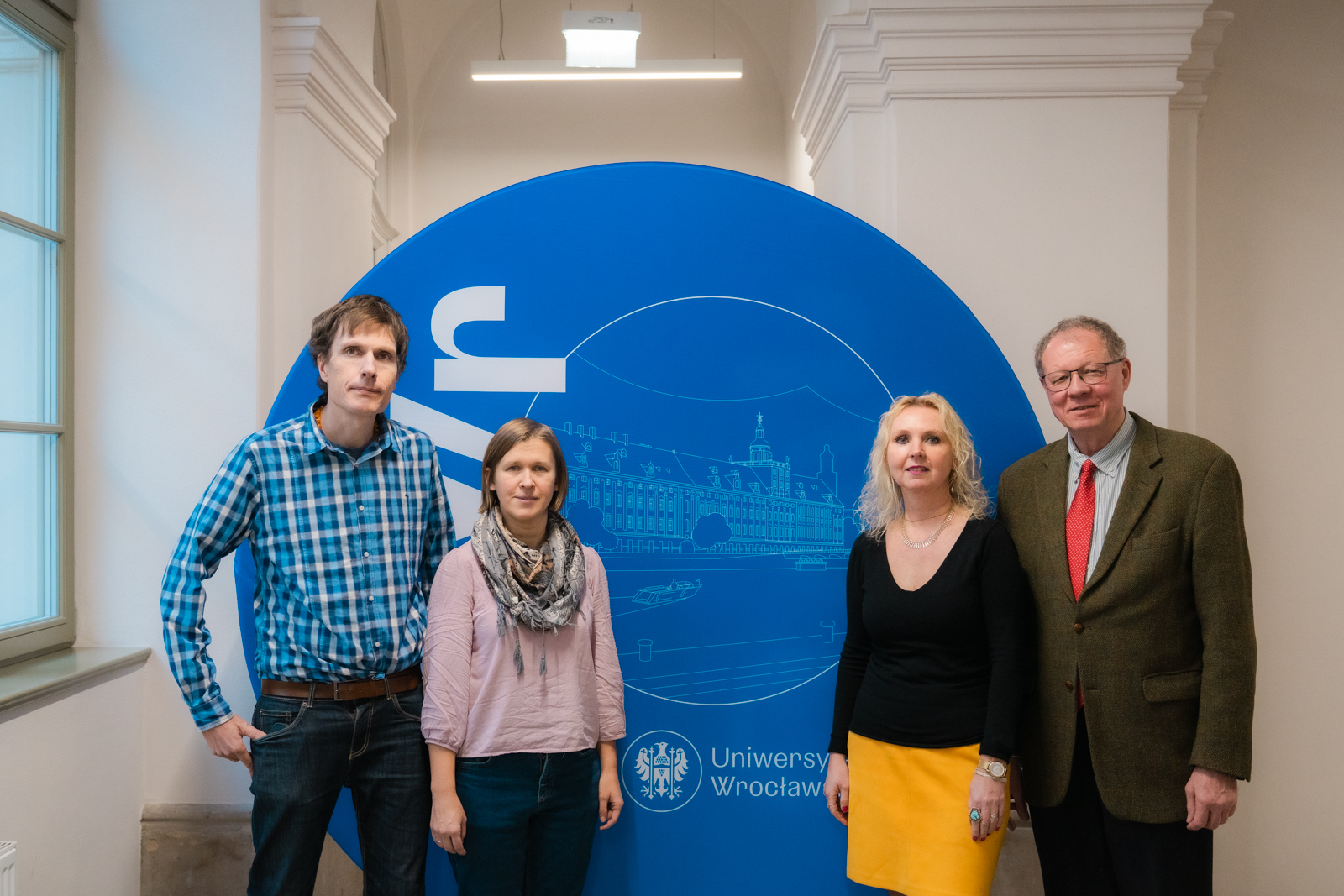
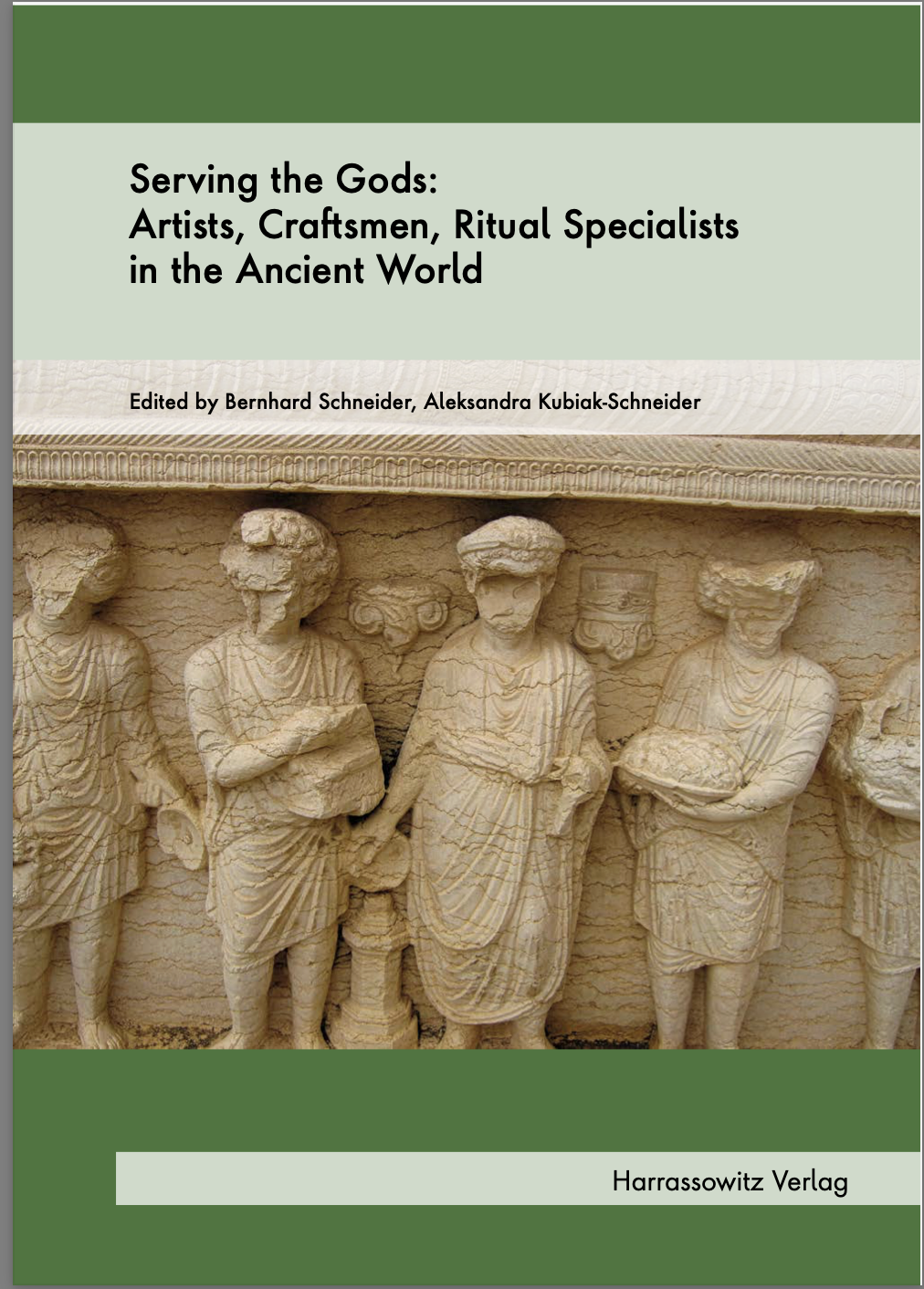
The book titled “Serving the Gods. Artists, Craftsmen, Ritual Specialists in the Ancient World,” published recently by the remarkable Harrassowitz Verlag publishing house, we are discussing with its editors: dr Aleksandra Kubiak-Schneider and dr Bernard Schneider from the Center for the Study of the Ancient World of the Faculty of Historical and Pedagogical Sciences of the University of Wrocław, as well as the authors of the articles: prof. dr hab. Krzysztof Nawotka — head of the Center for the Study of the Ancient World — and dr hab. Agnieszka Wojciechowska from the Faculty of Languagues, Literatures and Cultures.
Published, now available in open source, with the support of IDUB Publication Support Fund.
Ewelina Kośmider: “Serving the Gods. Artists, Craftsmen, Ritual Specialists in the Ancient World,” is the direct result of the workshops of The Melammu Project, which took place at the University of Wrocław in September 2024. To begin with, let us explain what the project entails and who it brings together.
Prof. dr hab. Krzysztof Nawotka, head of the Center for the Study of the Ancient World, the Faculty of Historical and Pedagogical Sciences of the University of Wrocław: Melammu Project, which stands for “divine spark” in the Akkadian language, gathers the scientists from all over the world studying Babylonia and the broad spectrum of the Ancient Middle Eastern Culture. The name was not chosen randomly — the world-class scholars founded the project. The main person decades is Prof. Robert Rollinger from Innsbruck, who spent four years at the University of Wrocław, thanks to the “NAWA Profesura Gościnna” program. He is the leading expert in ancient empire studies. Through the Melammu Project, two types of events are taking place – larger-scale symposia and shorter, focused workshops. The gatherings usually take place in various places — twice in Wrocław so far. In recent years, we gathered in Vienna, Innsbruck, or London, among others.
Dr Aleksandra Kubiak-Schneider, Center for the Study of the Ancient World, the Faculty of Historical and Pedagogical Sciences of the University of Wrocław: One of the symposia took place in China.
Prof. dr hab. Krzysztof Nawotka: Last year’s workshops in Wrocław were well-organized, and what is quite unusual, the scientific resources were published explicitly fast. I’ve got to say it was an enormous success.
Dr Aleksandra Kubiak-Schneider: It took us a year to do that.
Prof. dr hab. Krzysztof Nawotka: It is pretty common to wait four years or even more than that for the publication! That is why I feel a need to really praise our younger colleagues — they did an extraordinary job and selected a great publishing house. Harrassowitz Verlag, with its office in Wiesbaden, is an institution in which, for over a hundred years, the biggest luminaries have published their studies of the Middle East.
E.K.: The workshops in Wroclaw focused on looking at the Center of the Ancient World Culture from a different perspective — not through religious purpose or architectural practices, but from an administrative and economic standpoint. You were analyzing how cultural facilities were managed, paying close attention to the various social groups that enabled those great religious organizations to function. Please elaborate on that approach.
Dr Aleksandra Kubiak-Schneider: The idea for approaching the problem from this perspective was inspired by two projects: “Polonez Bis,” co-founded by NCN, and “Horyzont 2020 Marie Skłodowska-Curie,” which we carried out with my husband, dr. Bernard Schneider. He is studying the background of an essential Culture Center in Mesopotamia – the city of Nippur. He is analyzing not the city itself but the countryside surrounding it.
Dr Bernard Schneider, Center for the Study of the Ancient World, the Faculty of Historical and Pedagogical Sciences of the University of Wrocław: The first ones in the post-war history of the University. Previously, Mesopotamia was studied by Prof. Bruno Meissner, a German researcher combining archaeology with philosophy (connected to the University of Wrocław from 1904 to 1921 — [Ed.]). Currently, I am conducting an archaeological project in the countryside around Nippur, which is, in fact, the only research project of the University in southern Iraq. We conducted a site survey and will excavate the site, dated to approximately 500 BCE, in the first three months of the year.
E.K.: In your article, you are focusing on the analysis of the excavated material in the form of bricks used to construct the Mesopotamian temples. What did you discover in Nippur and its surroundings?
Dr Bernard Schneider: Before I even started conducting the current project, I had discovered how long-lived the Mesopotamian sanctuary in Nippur was. After the new Babylonian ruling dynasty, with the most important figure being King Nabuchodonozor II (ruling approximately 630-562 BCE — [Ed.]), the ziggurat was still being reconstructed as a traditional “ziggurat,” at least until approximately 150 BCE. I realized that, for science to learn more about that matter, it is necessary to study the areas surrounding the city and the rural areas that contain archaeological resources preserved from other periods. We wished to see whether we could find any evidence of what was happening in Nippur during the time of the existence of major urban districts. Such a huge initiative, in the form of the biblical Tower of Babel, requires the organization of a major labor force; thus, we were curious whether that would be visible in the province. At the site, we found multiple stamped bricks from the time of Nabuchodozor, which, in itself, is not extraordinary. Still, there is something more interesting about it: the findings suggest that a brick production center may have existed in a rural area beyond the larger city. If the major temple is being built, or the ziggurat, there is a need for a massive production facility to produce millions of bricks, as such construction requires.
E.K.: What was the distance between the city and the brick production center?
Dr Bernard Schneider: We define it in terms of days: there were four to five travel days upstream by boat required. We are sure of that because a German expedition from a nearby town, Fara, to Babylon used a similar means of transport for a five-day journey. All the resources needed for the brick production process were transported up and down the canal, making it a kind of “ancient highway”. With this route, the wood and the reed had been delivered. It is not clear exactly how the organization of such a production center was carried out, but it is clear that, to ensure supplies did not run out too soon, the facility had to cover a large area.
E.K.: This means that the water transport was mostly used?
Dr Bernard Schneider: Yes indeed. We already knew about the brick transport from the sources written in the Innana Temple in South Uruk. We know that the bricks transported from there were used in the construction of Babylon, but we had never discovered any proof in the form of excavations. Producing such a large number of bricks generates significant smoke, so it seems practical to transport them outside the city.
E.K.: In your article, you mentioned that the bricks were recycled.
Dr Bernard Schneider: In one particular case, it seemed that bricks could be reused in synthetic basalt production. This material was discovered in the canal branch from the later period, which was located in the same area. This region was a center of brick production for 2,000 years BCE, and American expeditions earlier identified it as a high-quality clay area. Findings from the later periods need to be carefully examined in the laboratories.
E.K.: In your publication, you present a study concerning a group that had an essential meaning of the function of Egyptian sanctuaries — the priests. In the times of the pharaohs, they served not only as religious officiants but also performed various administrative duties; one could say they held a monopoly over many professions in ancient Egypt. What were they taking care of?
Dr hab. Agnieszka Wojciechowska, Department of Neo-Hellenic and Near Eastern Studies, the Faculty of Languages, Literatures and Cultures of the University of Wroclaw: In ancient Egypt, priests served a very significant role. What is interesting is that the priest assigned to a particular temple could serve the same duties in another temple in another part of Egypt. It was very common for one person to hold a couple of titles in different temples at distant locations — in Upper and Lower Egypt, for example. In addition, they performed administrative duties and helped authorities exercise their authority. We are obviously talking about the highest-ranking priests, who come from the elite. The title was passed from father to son. The priest’s families could live in one temple their entire lives. Officiants were also responsible for the grain harvest and could serve in the military profession. They oversaw the construction of the temples, including the selection of what would adorn their walls and even the management of the quarries.
E.K.: To be fair, I am most interested in the last, the specifically technical role.
Dr hab. Agnieszka Wojciechowska: They were responsible for the stone production facilities because the supervision over this process was incredibly significant. They were required to choose a suitable stone, which was usually carved in large blocks. Monolith obelisks, for instance, were carved as a unit. Transporting such a monolith was highly complex due to the need to avoid damage. Depending on the type of building being constructed, various types of stone were needed, including those later covered with paintings. Such activities covered most of the priests’ duties.
E.K.: The important administrative tasks were those which we could name nowadays as notarial.
Dr hab. Agnieszka Wojciechowska: Each person who needed to draft a document, such as a contract, came to the temple. Priests who could read and write were drawing up such contracts. It was a common practice, especially during the Pharaonic period in Egypt. They were drawing many different trade contracts and marriage agreements. The latter were very important documents in those days, reflecting the high status of women. In the case of the death of the husband, the woman was secured by the contract.
E.K.: The marriage agreements concerned only elites, I suppose?
Dr hab. Agnieszka Wojciechowska: Yes, the upper and middle class. For the agreement, a payment was required, of course.
E.K.: Is it known exactly what was securing the women in such contracts?
Dr hab. Agnieszka Wojciechowska: They could be given an agreed amount of linen, which was one of the main materials stored in bales inside large crates. They could also get security in the form of bullion bars, most often the so-called “silver of the god Ptah”. They also received jewelry and other items — everything the woman would inherit was described in the agreement. Such agreements were drawn up throughout Egypt; similar documents were found even in the very south of the country, on the so-called Elephantine island, which was home to the Jewish community.
E.K.: How did the priest status change with the emergence of the Greco-Roman period?
Dr hab. Agnieszka Wojciechowska: It has changed significantly. The Romans introduced new administrative offices, including “Grapheion,” which functioned in a separate building with the same name. The temple’s area then stopped serving an administrative role. What is interesting is that Grapheions were appearing not only in metropolitan areas but also in larger villages. It was a significant improvement for a local community, which could draw up contracts without having to travel to the cities. In those times, documents were written in Greek before all else. However, sometimes the bilingual agreement existed — a Greek document with elements of the last Egyptian writing (demotic). In such cases, we see a document written in Greek, with, for instance, the names at the bottom in both Greek and demotic script. That is also when the witness institution was created, and they also had to sign the documents. Usually, they did it in Greek, but sometimes also in demotic writing. Those changes completely reorganized the way the Egyptian temples functioned. The priests lost their privileged status in Grapheion’s name.
E.K.: The shift in the status of the priests is linked, as you underline in the article, to the degradation of native Egyptian culture, which began to be overpowered by the primacy of Hellenistic culture.
Dr hab. Agnieszka Wojciechowska: Yes. The ruler of Egypt ruled through the highest-ranked priests, members of the Egyptian elite, who were highly decisive. In the Hellenistic period, everything changed gradually. The temple becomes a place where you can make sacrifices and praise the gods. It no longer has an administrative role, though. Thus, the priests lose a large part of the territory they previously controlled. Besides all that, in the Hellenistic period, Greek buildings began to appear in Egypt. Not all of them are archaeologically approved; some are documented in papyri and partly in ostraca.
E.K.: What are the ostraca?
Dr hab. Agnieszka Wojciechowska: They are shards, most commonly broken fragments from vessels containing short written texts. They were present mostly in the territory of Egypt. On ostraca, commercial documents, and records related to the activities of a city, such as the transport of grain to the city treasury, were recorded. Occasionally, shorter and longer literary fragments were also inscribed on these sherds. Returning to the changes that occurred in Egypt during the Hellenistic and Roman periods, it was precisely the emergence of new architecture: theaters, bouleuteria, prytaneia, and baths.
E.K.: What were the bouleuteria and prytaneia?
Prof. dr hab. Krzysztof Nawotka: Bouleuteria is like a current city hall, and prytaneia would be a building of city administration.
E.K.: In addition to archaeological material and sources available in archives, you used epigraphic sources. Professor, did you study the epigraphic culture of Miletus?
Prof. dr hab. Krzysztof Nawotka: Yes indeed. Let us remember that epigraphic sources are ancient inscriptions carved by human hand in stone, using tools that have survived to our day. Hundreds of thousands of them were preserved. There are approximately 570,000 published Latin inscriptions, while we estimate the number of Greek ones at about 200,000. The question is: why did people create them? The answer is quite simple — so that they would last forever. That is how they were perceived. They have survived, though we assume that only about 5% of those once produced have been preserved. All three of us are, in fact, involved in a large project that involves counting inscriptions from all over the world, particularly from the Eastern Mediterranean. We are doing this to draw various conclusions: determine which periods saw more or fewer inscriptions; what types of inscriptions they were; how they changed over time; and what impact historical events had on them.
For the publication “Serving the Gods,” I authored a chapter dedicated to the prophets and prophetesses of Miletus. Contrary to popular belief, the Greek prophētēs was not someone who predicted the future, but rather the individual managing a great temple where an oracle was located. An oracle is a place where one comes to ask god about the future. Whenever I speak about this at conferences, someone asks if one could ask about lottery numbers. Asking such questions would be showing a lack of respect for the god. A paraphylaks—the chief of the guard—was always present in the temple, and he had several strong guards with clubs who would simply throw out any offender. The questions were different: I am going on a sea voyage to Italy – should I offer a sacrifice to Poseidon? The answer would be: Of course, that is a pious and laudable act. Or — quoting an authentic oracle: The altar of Tyche stands in a place overgrown with bushes. Should it be moved? The answer: Of course, it should be moved. In Didyma, we have several dozen real oracles preserved on stone. However, the largest number in the world comes from Dodona in Epirus, near Ioannina in western Greece—about 2,000 inscriptions have been preserved on lamellae, or thin lead tablets, of which only 120 have been published so far. Most questions were asked by ordinary citizens, considering everyday life. While the prophētēs managed the oracle, a woman performed the act of prophesying — she might hold the title of prophētis or promantis, both of which we translate as prophetess.
How do we know all this? From a very rich body of epigraphic material. From Miletus and Didyma, we have about 2,800 inscriptions, suggesting that there were likely over 50,000 originally. These are often well-dated, high-quality texts. In these sources, 223 prophets known by name and five prophetesses appear. This represents one-third of all known prophetesses in the ancient world.
E.K.: What is the reason for such divergence?
Prof. dr hab. Krzysztof Nawotka: We don’t know that. None of the sources revealed that information. We should add that both prophets and prophetesses belonged to the same social class—Miletus’s highest elite: richest citizens and most influential politicians. From the famous Oracle of Delphi, we do not know the name of a single prophetess, even though it functioned for 1,500 years. We know that those prophetesses bore the title of Pythia. Since no name survived, we are sure that they were not recorded anywhere. The sources offer no explanation for this phenomenon, but there should be one, right? Using Didyma as an example. We have two very well-attested categories of notables associated with the oracle there: male prophets and the hydrophoros — girls performing a certain function in the cult of Artemis, the sister of Apollo. This event is nowhere precisely defined, but the name itself — hydrophoros (“a water-bearer”) suggests that they were responsible for providing water at a specific moment of the ceremony. All of them came from the local elite. From epigraphic sources, we know the names of over 120 hydrophoros, but only five prophetesses.
Let us consider what was more important: bearing the water or prophesying? Women did both, so the gender did not play a role, and the social status was identical. The names of the hydrophoros were recorded on a large scale, whereas the prophetesses’ were not. There must have been another reason behind them being unnoted, right? I suspect there was a cultural taboo that remains unknown to us today. The differences are significant, considering such large numbers.
Regarding the prophets from Didyma, we know about one-third of their names. It is an extremely well-noted group, mainly because of a negative human trait — vanity. At the end of their term, the prophets frequently commissioned inscriptions praising themselves, carved into stone blocks within the seat of the office. Thanks to this, we know a great deal about the highest elite of Miletus, to which all of them belonged. The last prophet attested by name was the Emperor Julian the Apostate, whose reign lasted from 361 to 363. The oracle continued to function even later, but he is the last prophet known to us by name.
E.K.: What do we know about the prophetesses?
Prof. dr hab. Krzysztof Nawotka: We can draw a few conclusions from the sources. Contrary to what many current authors write, the prophetess did not have to be a virgin — we know one who had children. All of them came from the aristocracy. Some of the prophecies were delivered in hexameter, so the prophetess had to be able to compose a verse. Which was nothing unusual – it was taught in school at the time. Every educated person was capable of doing this. The prophetess had to be educated and wealthy then. The final essential condition was that the candidate be capable of receiving a “voice of god.” Some fit better than others. There had to be a certainty that the woman would manage the task. Prophesying involved a special ceremony during which the prophetess spent three days underground. After her exit, she would appear in the window and deliver a response.
E.K.: Why was that a woman?
Prof. dr hab. Krzysztof Nawotka: From the oracle’s point of view, I would say that it was Apollo’s choice. We do not know that, of course. In ancient times, there were oracles in which women delivered the response — this was the case in Delphi and Didyma — but there were also those in which a man performed this role. For example, in the second most famous oracle of Roman times, in Klaros in Asia, the prophet was a man. It did not have to be a woman; nevertheless, in the two most important oracles, such a role was carried out by a woman. We do not know what this was a case of. Please remember that the sources always underline that God is delivering the oracle and the human is only a vessel, with no regard to gender.
E.K.: To get an answer from the gods, the prophetesses took a few days; that is a significant amount of time. There must have been a long queue of those eager to consult the oracle and a very long waiting time.
Prof. dr hab. Krzysztof Nawotka: We have to be aware that contemporary people treated the oracles completely seriously. They were considered unerring, which is why the process took so long. The “Promanteia” privilege existed — priority in consulting the oracle — meant there were certainly more applicants than opportunities to provide answers. This privilege was documented both in Delphi and Didyma. It is assumed that the oracle at Didyma did not operate year-round. As Apollo was the god of the sun, she did not function in winter, when the sun was low; the oracle was inactive. It is possible that the answers were given only once a month — we do not know that for certain. Thus, many factors restricted access to the oracle.
E.K.: Dr Kubiak-Schneider, in your article, which is part of the book publication, analyzes epigraphic sources as well, specifically those concerning the Middle East territories. You are focusing on social groups that were previously excluded from research: the professions responsible for constructing and decorating temples.
Dr Aleksandra Kubiak-Schneider: I paid closer attention to analyzing the inscriptions from places where I had enough data to research the topic. The places being: Hatra in Iraq, Palmyra in Syria, and Wadi Rum in present-day Jordan. What connects these sites is the Aramaic language and some cultural and organizational similarities. Most of the data I collected was in Hatra. The network of connections among the builders was particularly visible there within the family, especially as those professions were passed down from generation to generation.
When we say “builder”, we are imagining people standing on scaffolding, preparing mortar, or laying bricks. Here we have a different social range. In the inscriptions, a person was mentioned whose title is hard to interpret in Aramaic. He is usually translated as the “architect”, but this trade was responsible for much more than that: it was someone who plans, supervises, and draws up the project, and simultaneously has a practical knowledge of a builder. I suppose, due to the familial, clan-like nature of the workshops, they also handled decorations — sculptures and reliefs for the temples. They were preparing their sons for future careers. Inscriptions from Hatra suggest that they most often began as sculptors creating the reliefs, with time they were promoted to the head of construction, supervising the process and directing the tasks.
E.K.: When it comes to the architecture of the temples, were they monumental?
Dr Aleksandra Kubiak-Schneider: It depends on the place. In Palmyra, particularly in the Temple of Bel, it is, in fact, the monumental building: very tall, richly ornamented and columned, covering a large area. Similarly, in Hatra, the temple complex is also huge. However, in Wadi Rim, the Temple of Allat was modest, yet within the local architectural context, it was still considered a massive structure. It had clearly visible columns and richly decorated capitals. In Hatra and Wadi Rum, there are connections among builders and royal houses. In Hatra, we do not have a clear confirmation, but we do know that builders and sculptors were associated with a specific deity — Barnaai (in Aramaic: the son of our Lords). This god was a patron of both the construction and the builders. There is an inscription listing the penalties for stealing tools from the “storage” belonging to this deity. It was a temple property, which is why the theft resulted in the deity imposing punishment. We can suspect that these were severe punishments like death by burning or water-trial — throwing into the river and observing if the person would be able to save themselves.
E.K.: Since the builders “belonged” to the god, does it mean that their lives also belonged to the cult?
Dr Aleksandra Kubiak-Schneider: Yes, and no. Based on the analogies from Mesopotamia, one can suspect that they had a specific role in the functioning of the temples, and that, from their families, priests were selected. It should be noted that, in contrast to the present reality, in Hatra, Palmyra, or Wadi Rum, the builders were part of the elite. They knew how to write and were extremely educated in the field of arts. In Hatra, there is an example of a sculptor who made a Stela with the city law inscribed on it. Beneath the image of the eagle, he signed in tiny letters: “Yhabshai, son of Barnaai, sculptor”. It is the same typeface as that which was used for the decree, so it was most probable that he was the author of the inscription. The builders were up to date with current trends in the ancient world — they combined traditional style with Greco-Roman nuances, used columns and the Syrian arch, and occasionally carved the stones in a more Greek or Roman style. I wanted to also ask about the Aramaic language. I admire the knowledge of such ancient languages. I understand that there are not many sources of information. How did you manage to learn it? It seems to be very complex. Did I correctly notice that it does not have any vowels?
Dr Aleksandra Kubiak-Schneider: Yes, it does not. I was studying this language intensively for a long time — first during my studies, then during my doctoral studies. It is worth adding that I am analyzing Aramaic inscriptions from the polytheistic sphere, not the Aramaic or Syrian biblical manuscripts — I do not have the necessary technical skills to undertake the analysis of the latter. When it comes to numbers, from Palmyra we have about three thousand inscriptions, and from Palmyra about five or six hundred. In Natabena, there are also thousands of inscriptions and graffiti; however, we do not yet have a full corpus. Early Aramaic inscriptions are much fewer, perhaps around two hundred. Aramaic does not belong to the hardest languages — Semitic languages are logical and learner-friendly. It requires mastering the alphabet, but the grammar is just much simpler than in Greek or Latin. There are some irregularities and complexities, especially when it comes to verb conjugation, prefixes, suffixes, or root alterations. But the inscriptions I am studying are most commonly very technical, recurring, and stable in form. It helps. Mistakes sometimes happen — for example, the subject’s plural form and the verb’s singular form — but it is possible to grasp them from the context. I am always comparing the work with the inscriptions to putting together jigsaw puzzles.
Translated by Mateusz Tomiak (student of English Studies at the University of Wrocław) as part of the translation practice.
Added by: E.K
Date of publication: 23.01.2026


