



Always with the shield!
For our researcher this experience was an adventure on the border of experimental archeology and experiential tourism. “I recommend this event to everyone who wants to truly experience the spirit of ancient Rome and expand their knowledge through practice” says dr Damian Werczyński.
Dr Damian Werczyński from the Department of Regional Geography and Tourism of the University of Wrocław speaks about his passion for science connected with life challenges and parental determination.
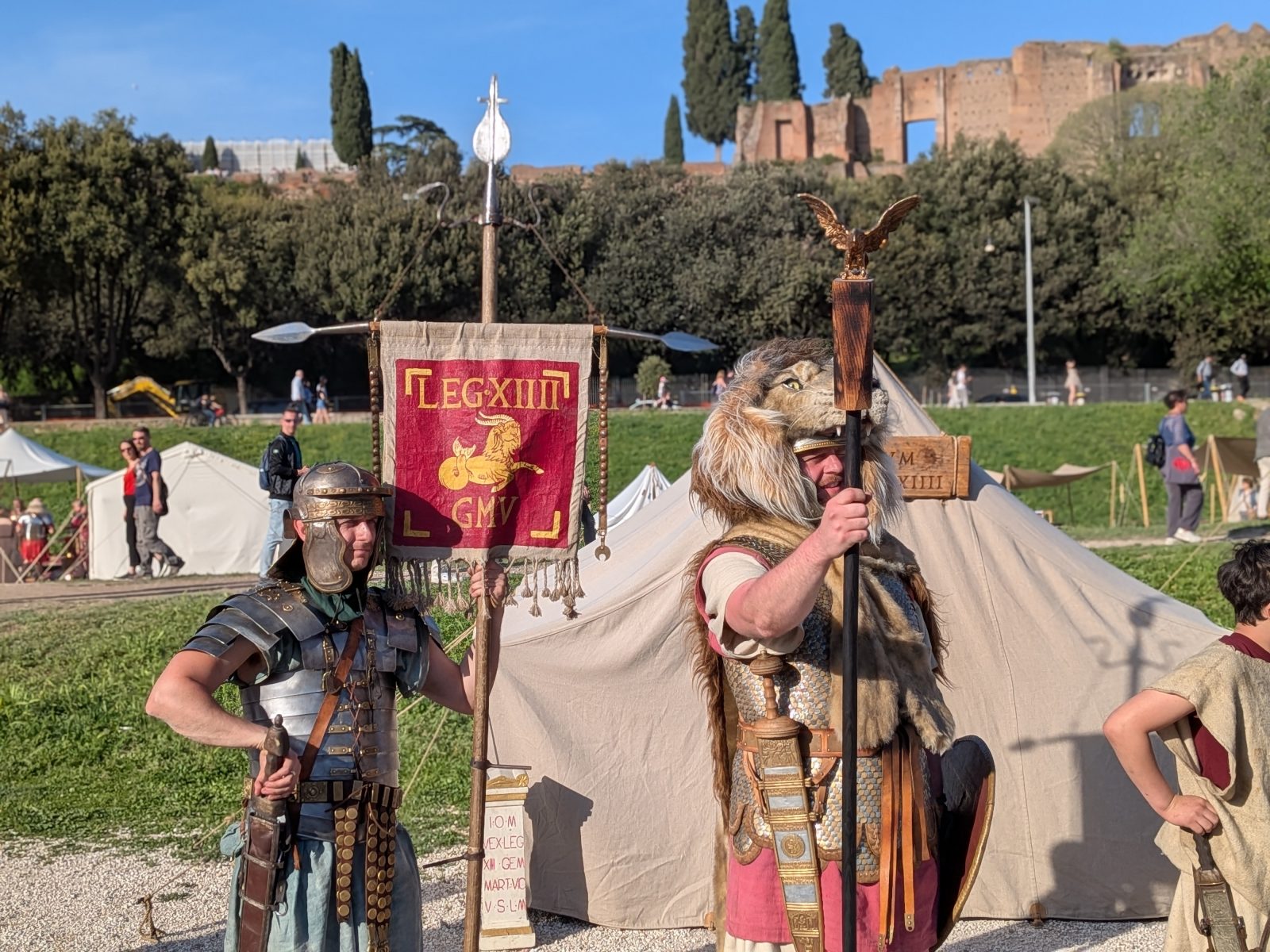
In April he took part in “Rome’s birthday” event, also known as “Natale di Roma” festival. The event attracted over 60 groups (over 1000 people), mostly from Europe, but not only!
Dr Damian Werczyński: Reconstructors from all over the world took part in the event. Besides the hosts, there were also groups from Germany, France, Romania, Czechia, Spain, as well as groups from more exotic regions, like Taiwan! It was a gold mine of information about the activities of these people and at the same time one could feel a spirit of unity and ancient Rome fascination.
Did you also decide to join the Roman Legion?
Yes! Thanks to the kindness of Legio XIIII GMV Pro Antica association I was accepted into the ranks, and what’s worth mentioning is the fact that the Legion was the only group that was registered from Poland. This made hundreds of people interested in visiting our camp whilst visiting Rome.
Where did the idea of joining the Legion come from?
Many years ago, I started combining my experience from both fields of study: archaeology and geography, that I graduated from the University of Wrocław. This is where my passion for archaeotourism came from, mostly popularization of archaeology, which I study at work. The activities of reconstruction groups fit perfectly in my interests, so when the opportunity of taking part in “Natale di Roma” celebrations arose, with people who are so experienced… I had to give it a try! The Legion is celebrating its 25th anniversary this year, so I don’t think there’s a better first-hand source to see what it’s like “from the inside”. I had a few goals of association members and very known today experiential tourism – sightseeing in which a main role-played experiences (meaning being a reconstructor and legionnaire). On the one hand, I wanted to “walk in the shoes” of a legionnaire, feel the weight of the gear (a jargon term for equipment, in this case, weapons) and the hardship of march. On the other hand, outside the shows, I was able to learn more about the motives of Pro Antica members, hear stories about the development of the group, ask about activities outside the reconstructions, and see how deeply committed are to what they do.
And it worked! Was it your first reconstruction episode?
No, I already had an opportunity to become acquainted with Legion XIIII, when a few years ago my colleague Ryszard Bartoszko, who also studied archaeology and graduated with me at the University of Wrocław, joined them. You could say he is a “fanatic” of ancient Rome, and today he is an advisor on substantive matters in the Legion. Other members joke that when they don’t know how a toga should fit on a senator or how a certain command should be pronounced, they should ask Rysiek. He was the one to invite me to participate in the “People of Fire” festival in Archaeological Museum in Wrocław in 2023, and there I had the opportunity to wear full outfit for the first time. Besides, the offer of permanent joining the Legion is still on….
What unites the members of the reconstruction group?
In Pro Antica surely a passion for ancient Rome and the desire to know more about it, through reading academic sources or crafting their own pieces of equipment. For some, this passion has always been with them, others acquired it with time. What should be highlighted here is that they are very passionate because they are doing it for free (or rather, they pay for travel, accommodation and equipment repairs), and they dedicate their free time to bring joy not only for themselves but also others – especially the youngest tourists, who are the most impressed by the shows.
Who are today’s Legionnaires?
“The Legion brings people of all ages together, working in different professions. The HR specialist and a Wrocław guide, banker-economist, a home design salesman, a student and dr. hab. of political science are marching side by side. And everyone, both during the show and especially after are a cheerful group supporting one another. You can see that people in Pro Antica derive satisfaction and energy from these meetings, because they make sure to book their calendars every season. Everyone works in good faith of the group, they take care of the equipment and actively search for new people that could join the Legion – the more legionnaires, the better effect during the show – they invite people all over Poland, but not only. During “Natale di Roma” festival there was a Polish student that came from USA, while being on Erasmus, that joined our show (thanks to his mum’s permission).
Are there any women in the Legion?
Although the legionnaires are men, women are also welcome in the Legion. They are dressed in period costumes and help during the shows with taking pictures, helping with equipment adjustments and ensuring the legionnaires stay hydrated. During the Italian heat it was very helpful, especially during marching through the city. The ladies also create parts of the outfit, for example by sewing “super comfortable” socks, that in my case saved my feet while wearing caligae (soldier’s studded sandals).
How does the equipment of Pro Antica’s legionnaire looks like? Is it just a plastic put all over the outfit?
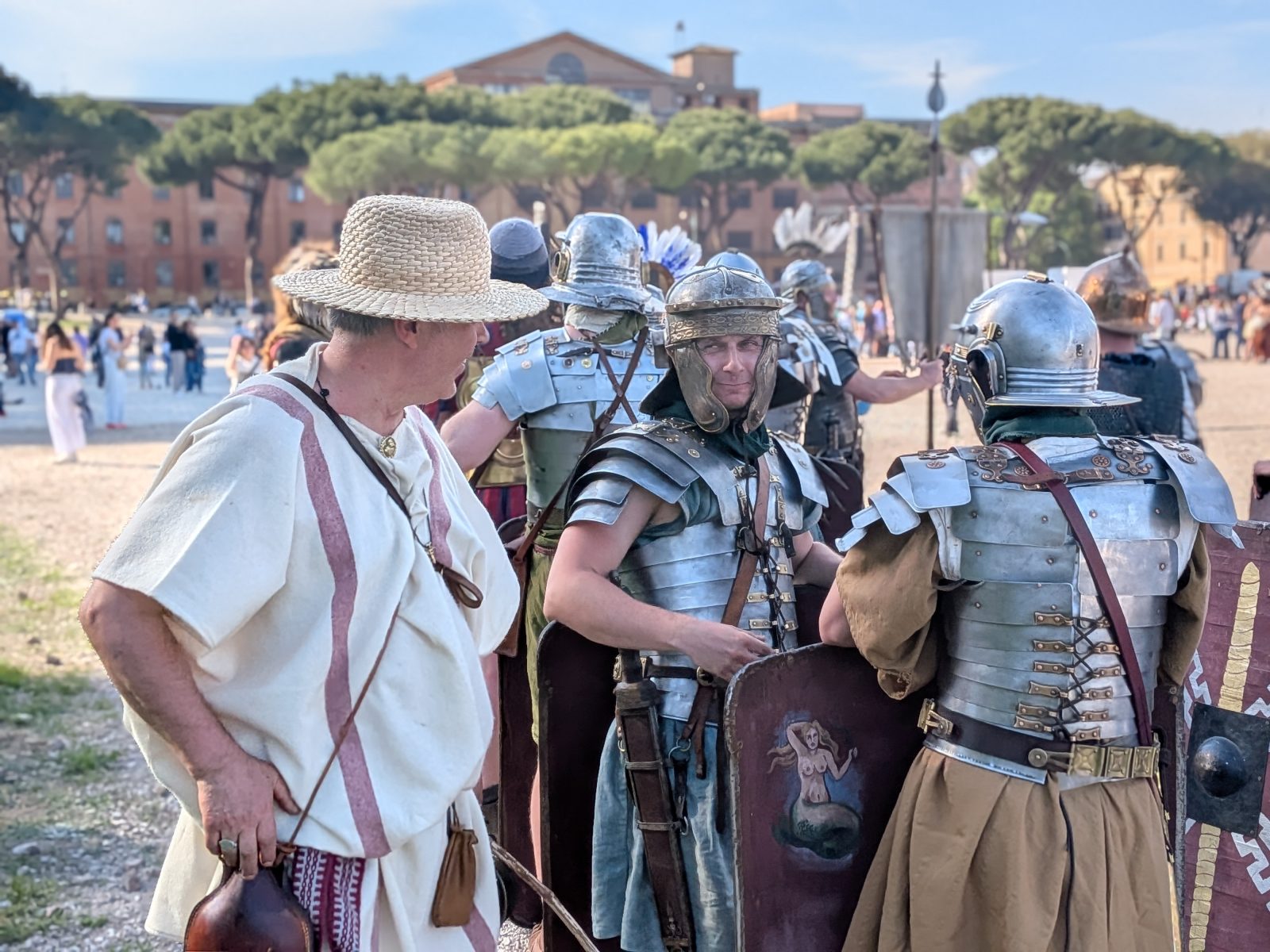
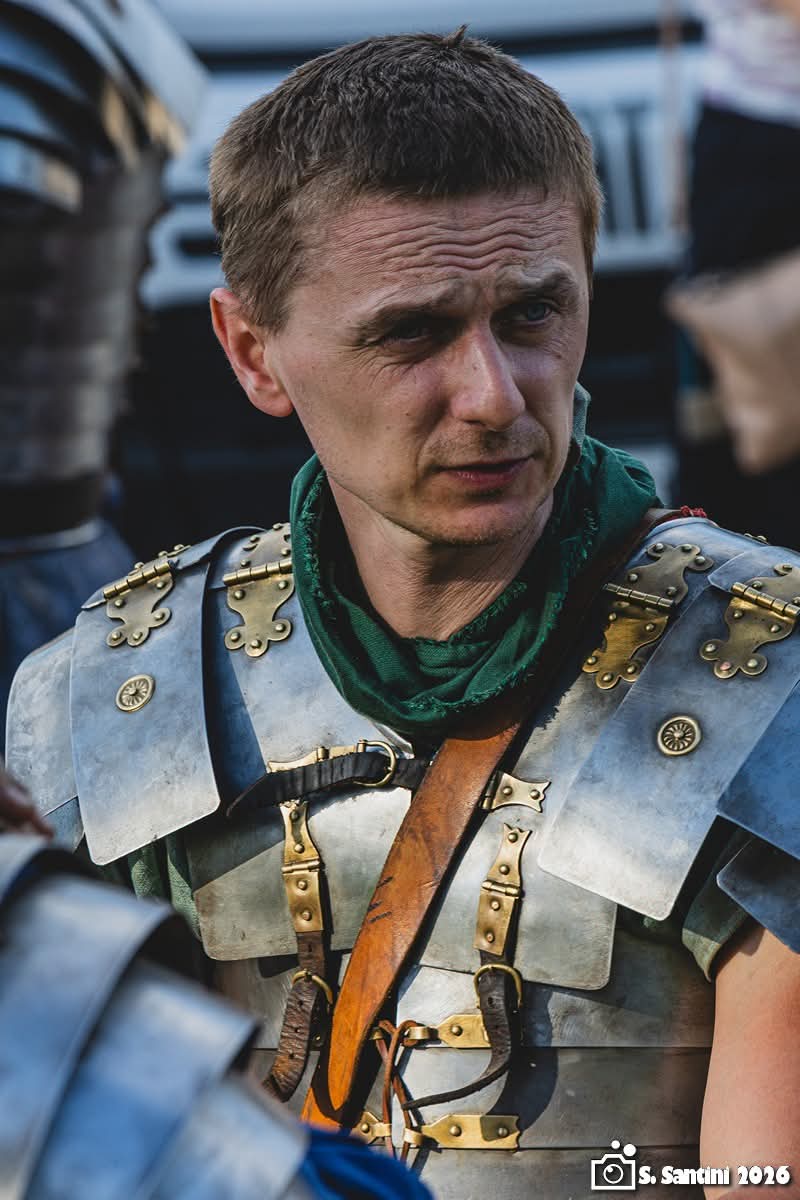
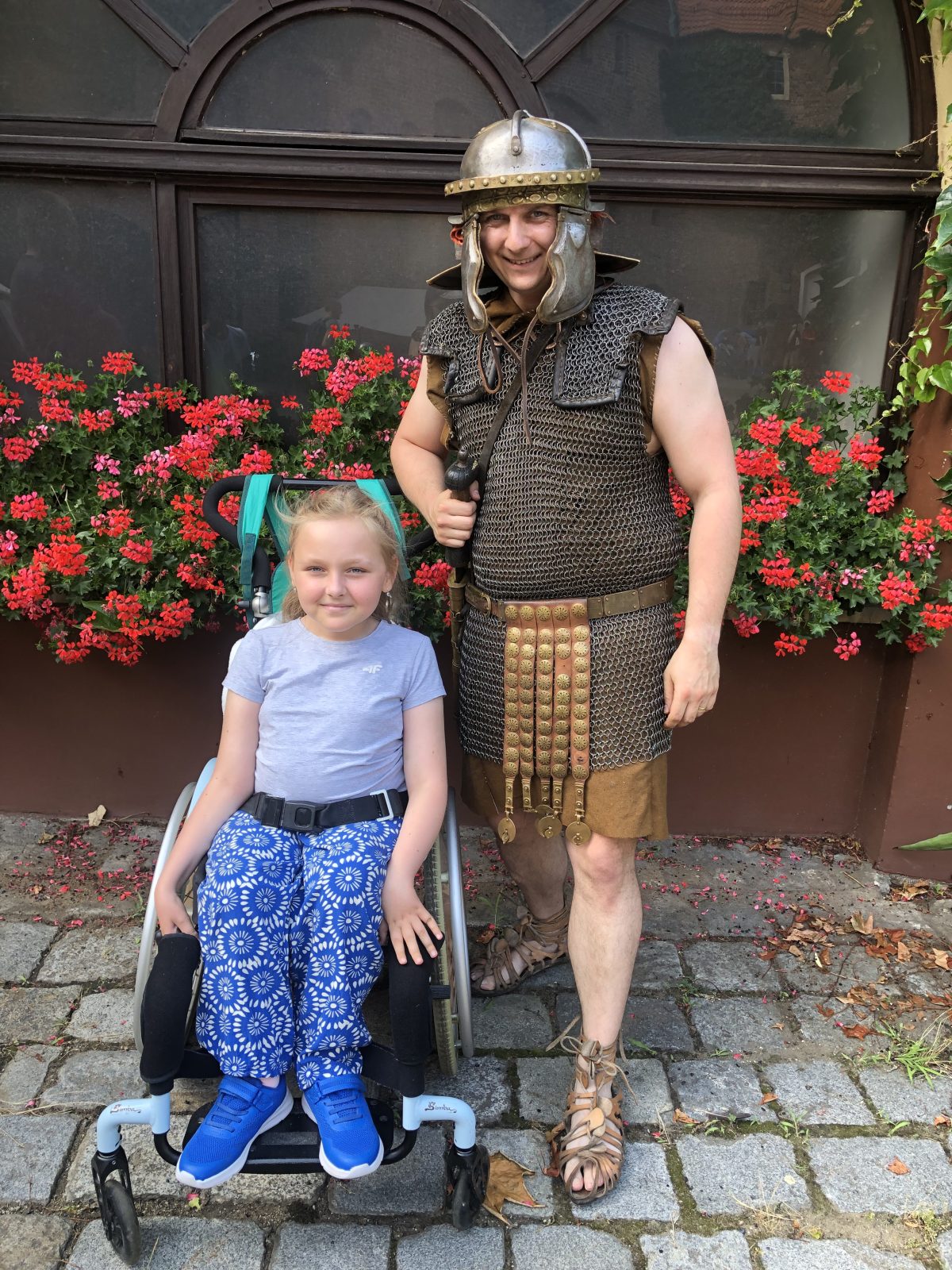
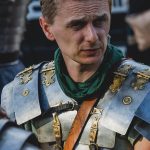
No way! We were able to compare the quality of equipment of our group with others. And our Legion when it comes to the accuracy of the reconstructions is truly amazing. All thanks to the members, who has been taking care of it for years, and making sure the equipment is as close to the original as possible. Obviously, you can’t see the differences with other groups at first glance, but when you come closer, touch or try them on… When someone wants to try the equipment on, you should be prepared to wear only your underwear – over this you put on a tunic and sandals with straps, and then other items and clothing. The segment armour and helmets are pure iron, right with other elements of the outfit they weigh around 18 kilograms! When it comes to helmets, it is important to wear something soft and thick underneath, to avoid a headache.
And then there’s the weaponry…
Of course! A glaudius (a short sword) is slung over the shoulder, a scutum (a shield) that weights around 6-7 kg and a characteristic javelin – a pilium weights around 2 kg. The full equipment and outfit weights 25 kg, which is the weight a Roman legionnaire used to carry. You could feel how much effort it takes just after wearing the outfit for 1-2 hours, especially during the march. And the advice from the members of the Legion is not to take a random shield, it needs to fit comfortably in your hand if you want to be able to finish the march.
What was the “Natale di Roma” event about?
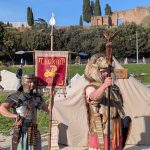
The main base for the legions that came to participate in the festival was Circus Maximus, which is a facility in the heart of Rome. This is where the legions camped, and the tourists visited, especially on the second day of the festival. The pictures were taken, and many questions were asked about the association’s members’ passions, organisation of their activities and recreation of their outfits. People wanted to touch the weaponry, try it on and even some asked how they can join the Legion.
The contacts with reconstructors all over the world were made. We talked with French people, from Arles, whose shows are usually held in the setting of ancient monuments, such as the local amphitheatre. Italian gladiators came to visit; they were fascinated by the lion skin worn by the signifer. The Romanians invited us for a delicious goulash and the centurion from Taiwan bounded so well with us that we took command of the Legion during the afternoon march through the city. You could see how much people actually enjoyed witnessing it!
The main ceremonies took place on Sunday and were divided into two stages. The first involved a nearly two-hour march through closed streets in the heart of Rome: from Circus Maximus, past the Theatre of Marcellus and the Altar of the Fatherland, along the Via Fori Imperiali, around the Colosseum and back to the Circus Maximus (approximately 4 km. Such experience allows one to appreciate the hardship a legionnaire had to endure, while wearing the full regalia. It also leaves an unforgettable impression.
The second stage of Circus Maximus was a huge performance based on historical events from the late 2nd century BC (among others the time of Sulla), culminating in a battle between several legions and barbarian tribes from Germania.
Was it worth it?
Of course! The reward for the effort put in march was the cheers and applause of thousands of people practically along the entire route. And the time spent at the camp allowed us to observe the activities of a reconstructor, develop a solid knowledge of the legions and see methods of interactions between reconstructors and tourists. Perhaps, another ancient fruit of this trip will be persuading one of my colleagues from Pro Antica to write a doctoral dissertation about the significance of the groups of reconstructors in interpreting the heritage of ancient Rome. We will see in time, and I’m keeping my fingers crossed and gently persuading her to agree, since her knowledge is enough to write such work.
Is there any chance we’ll see this group in Wrocław?
-Yes, shortly the Legion will visit Wrocław, you will be able to see them (even join them) live during the “People of Fire” event that will be held on 13-14 of June 2026, in Archaeological Museum.
Does your family share your passion? How do you reconcile this with your private life?
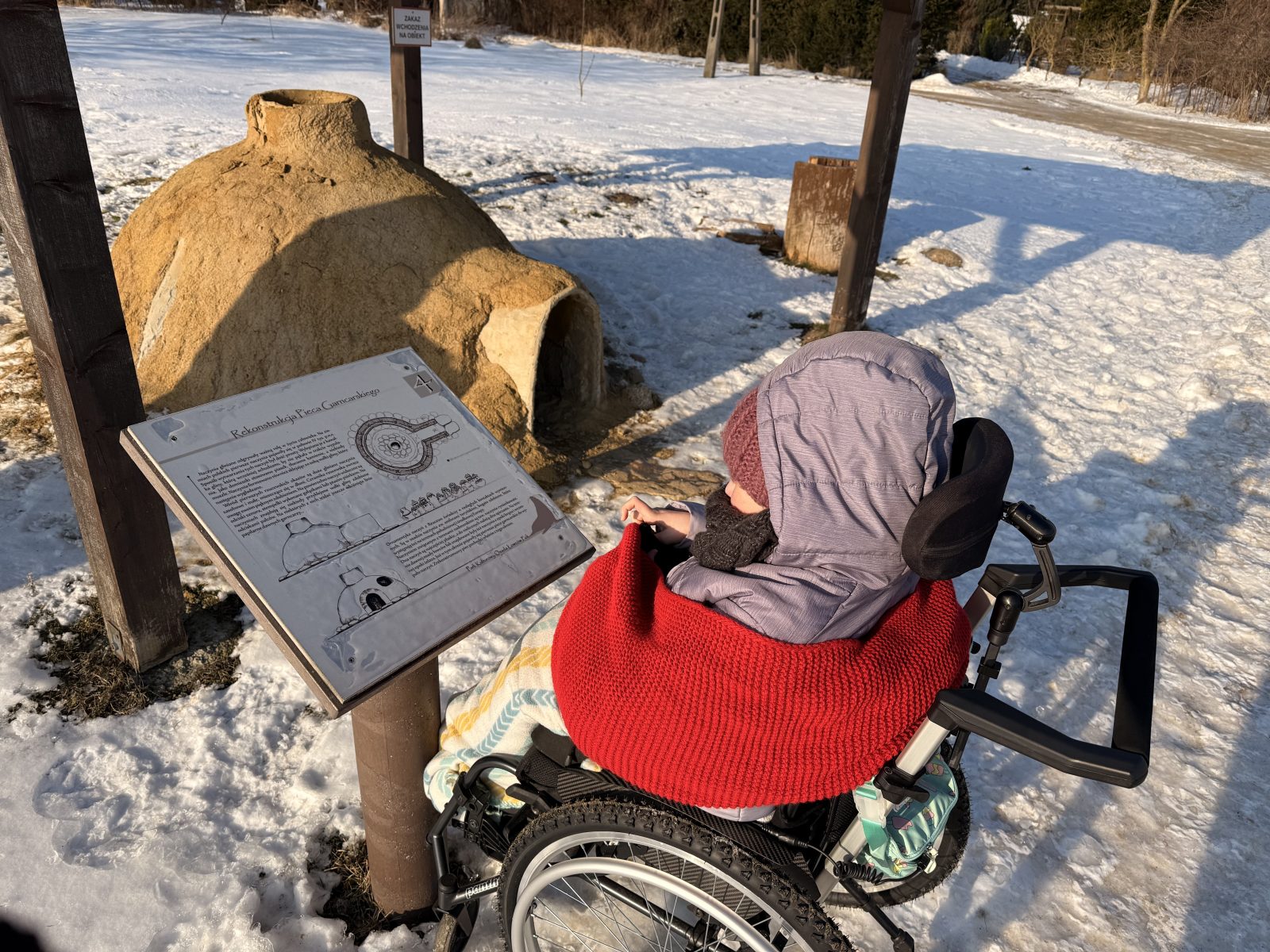
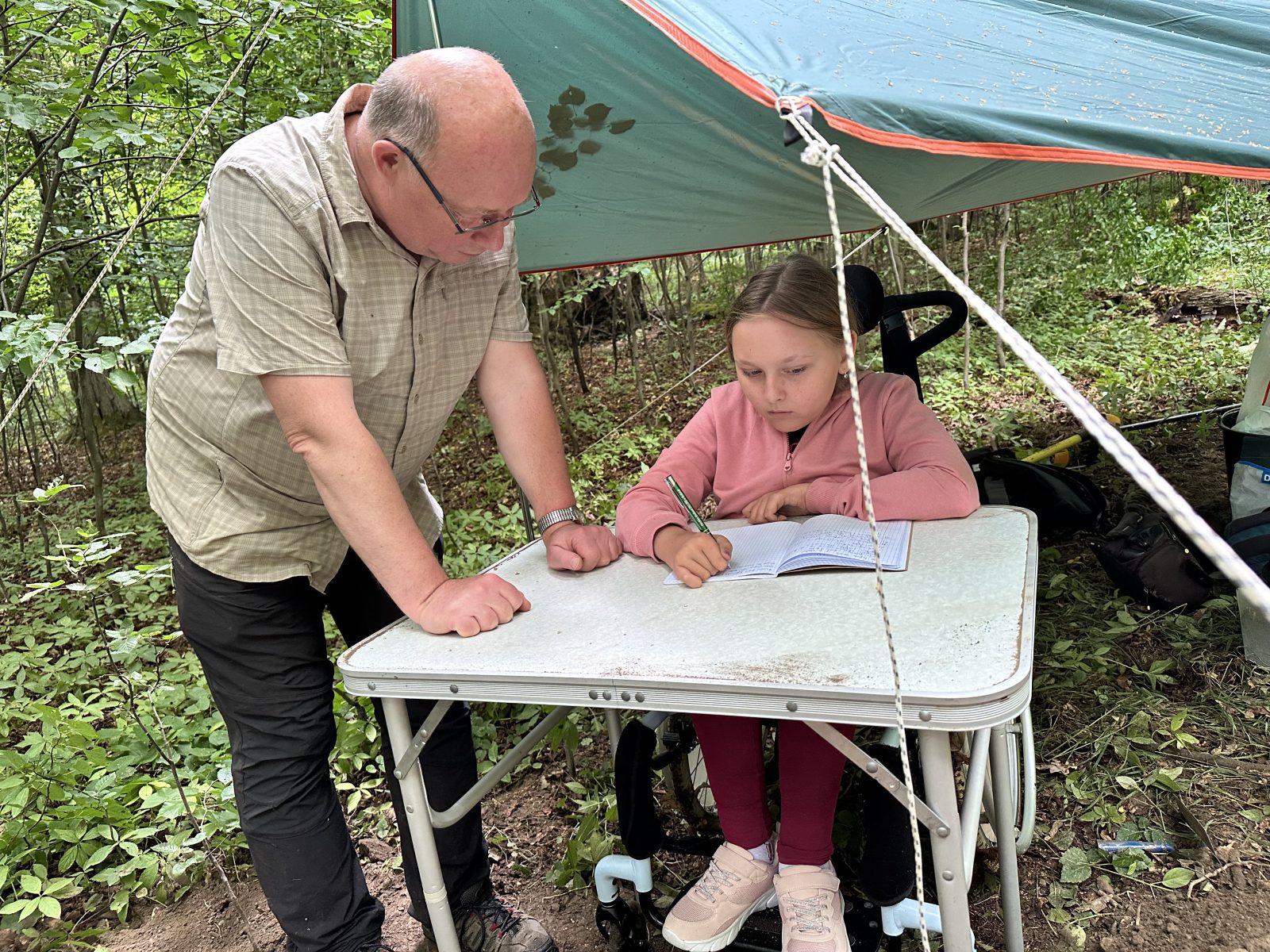
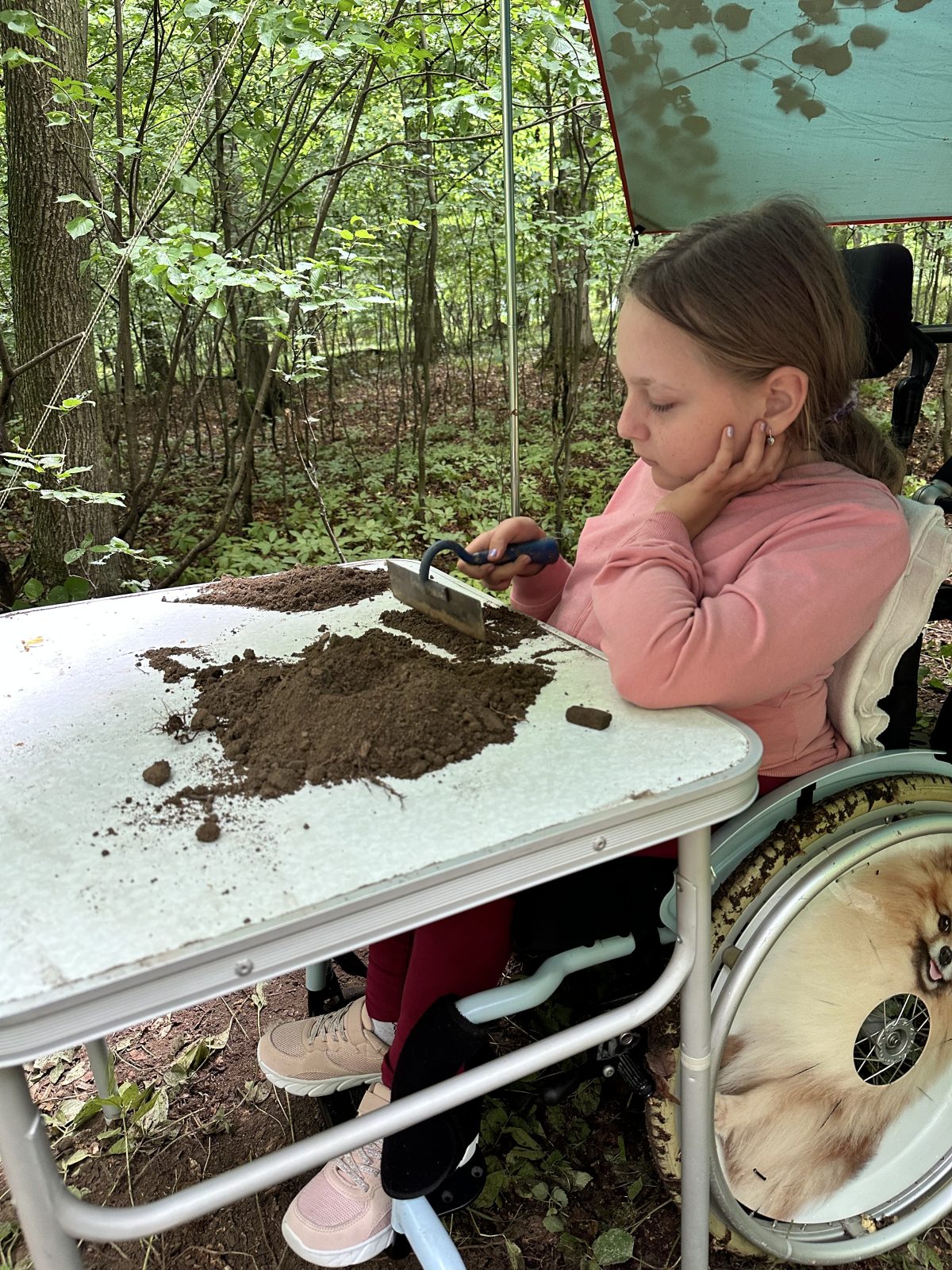
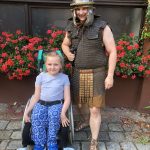
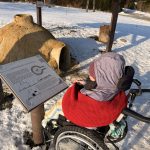
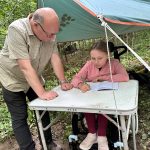
For “Natale di Roma” I travelled alone, but I usually try to have my wife and my two kids (11 -year-old daughter and 5-year-old son) with me during the trips. You could say I work all the time, since there are always archaeological sites and museums on the agenda. The one who enjoys that the most is my daughter, who shows a strong interest in history and archaeology. Unfortunately, due to her disability, she can’t always visit every place with me, as she suffers from SMA (spinal muscular atrophy) and uses a wheelchair. However, my wife and I are really determined to show her as much as possible. My daughter helps me at work, because by pushing her wheelchair, I can perfectly assess the accessibility of museums and archaeological sites to the needs of disabled people.
Forest fortifications or castle ruins aren’t usually associated with accessibility… What it looks like in practice? Which places have you and your daughter visit?
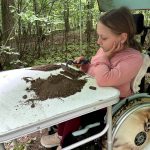
Usually, the archaeological sites or reserves are less accessible to wheelchair users. But you can see significant progress in that in recent years. My daughter was able to see most part of ancient Pompeii and the Scottish castles (Stirling, Tantalon). This year’s trip to Rome was to see the progress of infrastructure preparation. And I already know that comparing it to previous years, we will be able to see Forum Romanum and Paatine Hill, as well as the Forma Urbis Romae Museum, while on wheelchair. In Poland this year, we visited the seal hunters’ settlement in Rzucewo and the hill fort in Sopot. My daughter’s desire to visit every place motivates me and my wife to stay fit so we can always manage to push or carry the wheelchair. Sometimes, even if there is no infrastructure, after given permission of staff we enter anyways. Thanks to one of my daughter’s teacher she was also able to see walk the entire route at Ogrodzieniec Castle during a school trip. Furthermore, in 2025 thanks to invitation of prof. Krzysztof Jaworski of Institute of Archaeology at the University of Wrocław, we could participate in excavations at the Gilów stronghold.The dense forest was the biggest obstacle, but we managed to get through it.
Damian Werczyński from the Department of Regional Geography and Tourism at the University of Wrocław – doctor of Social Sciences(discipline: socio-economic geography and spatial management, 2023), and an MA in archaeology (2009) and geography (2012). His research interest for tourism geography, especially archaeological tourism and methods of interpretation of cultural and natural habitats. Member of the Polish Geographical Society,licensed tour guide and academic tutor, for many years a teacher in the International Baccalaureate Programme (IB DP), teaching geography and business management.
Author of the book “Stanowiska archeologiczne na Dolnym Śląsku jako walory turystyczne”.
Translated by Nikola Dawidowicz (student of English Studies at the University of Wrocław) as part of the translation practice.
About the passions of people of the University you can read below:
Śpiewająca solistka
Muzyka w moim sercu
Być w najpiękniejszych miejscach na świecie i Uniwersytecie
Nietoperze moja miłość
O pasjach ludzi Uniwersytetu. Małe dzieła sztuki – Uniwersytet Wrocławski
Edit. Katarzyna Górowicz-Maćkiewicz


