



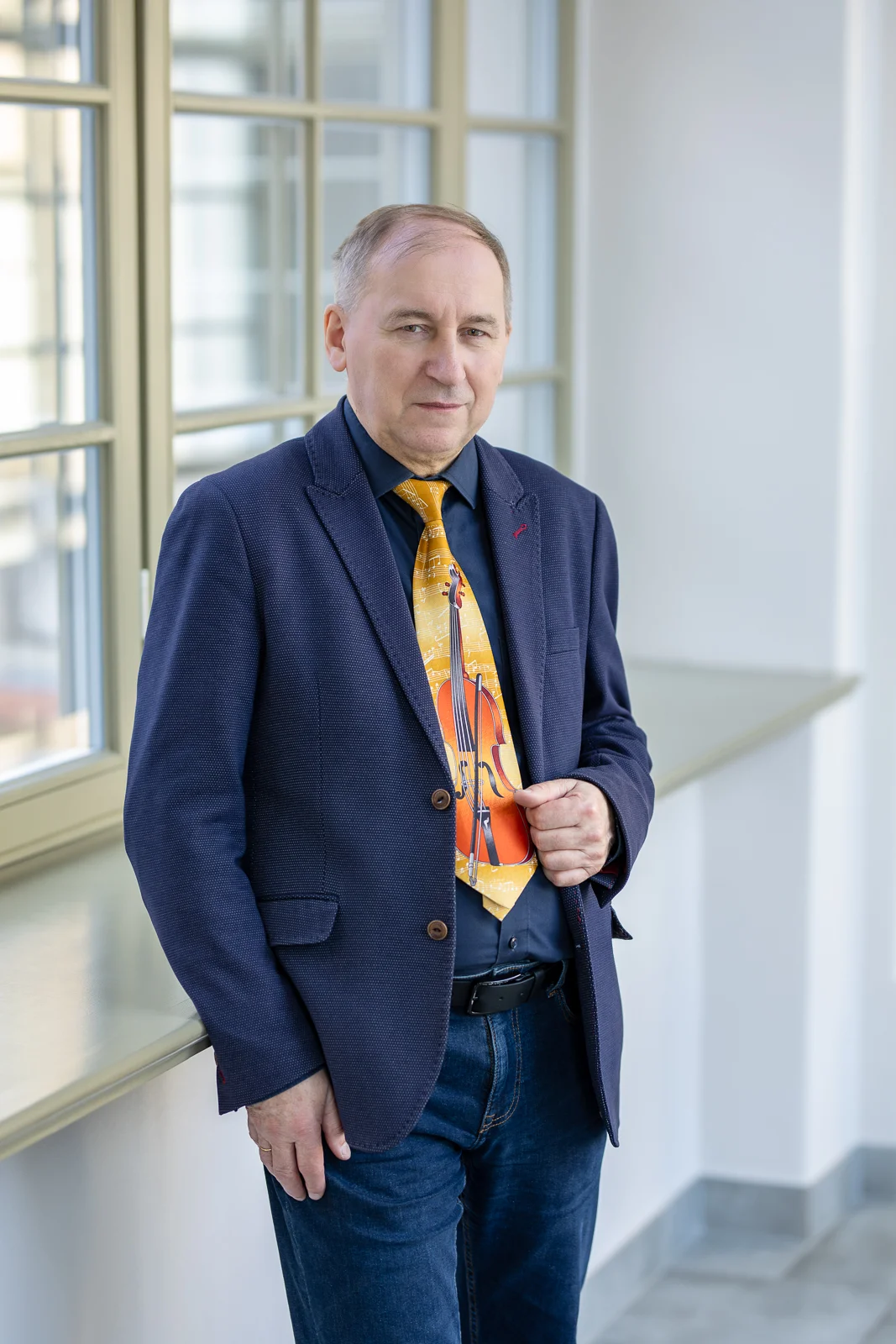
Christmas carols as heritage: between the liturgy, tradition and the modern world
The upcoming Christmas season holds a special place in the liturgical year of the Church, and the music associated with it is one of the central fields of musicological research. Throughout the centuries, the Christmas repertoire not only served a utilitarian role in church services, but also reflected the stylistic, aesthetic, and cultural transformations occurring in church music of particular periods.
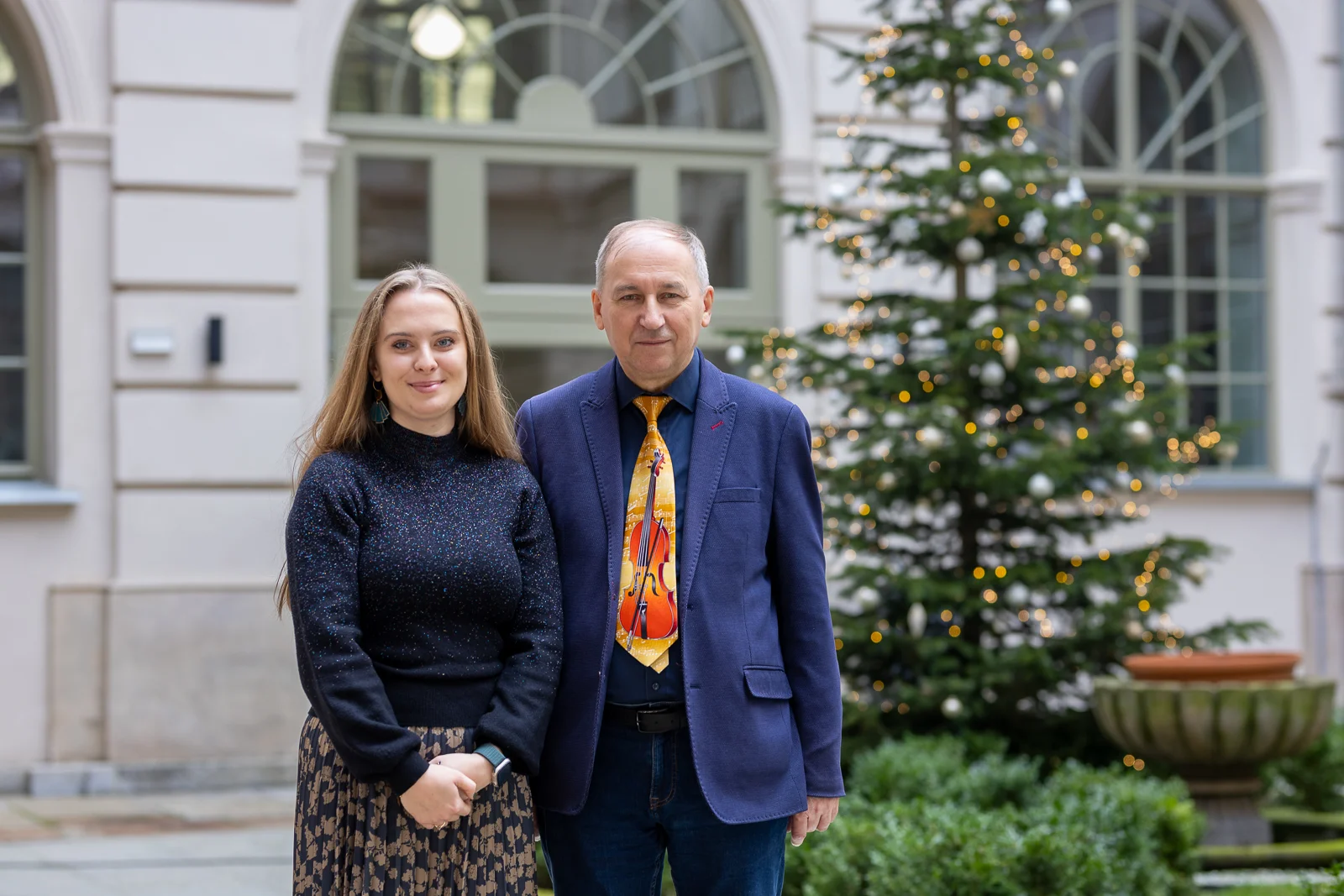
We invite you to read our interview with Professor Remigiusz Pośpiech, musicologist, Director of the Institute of Musicology at the University of Wrocław (since 2020), scholar of Polish music of the XVII-XIX centuries, the history of Silesian music culture, and post-councillor liturgical music. He has published multiple papers on liturgical repertoire and is a specialist in the music tradition of Jasna Góra, one of the most important centres of religious culture in old Poland.
Maria Kozan: How does the practice of carolling look nowadays?
Ewelina Kośmider: Do the present-day Polish people enjoy singing carols, and can they still do it?
Remigiusz Pośpiech: Recently, I gave a lecture to a national minority in my hometown, during which I spoke about the custom of carolling in Silesia. I encouraged the participants to sing carols, though I must acknowledge that nowadays it is not an easy task. I observe it on my own example- I encourage others, while I have to motivate myself as well. It is much more convenient to play a recording, especially since I own a large collection of CDs, so one can listen to it for hours without repetition. However, singing requires an entirely different kind of engagement. Alongside my university friends, since our studies, we have been maintaining the tradition of carolling together. Every time, before we begin, I turn off my phone; even if we do not sing for the public, we treat this moment with due attentiveness. Every year, we meet in a circle of about 20 or 30 people to carol together.
EK: For a person outside the academic environment, it may seem that in Poland, the custom of communal carolling is exceptionally rich in comparison to other countries. I am not sure, but is my intuition right?
RP: Such a conviction is quite popular. But carols are sung in all Christian countries-this is the common cultural heritage owed to the Franciscan Order, especially St Francis of Assisi. To him is ascribed the construction of the first Christmas crib, which showed the Nativity scene as a very human, almost daily occurrence. Although Christmas music is much older, dating back to the early days of the liturgy of the Nativity, around the 4th century, first in Jerusalem, then in Rome and other centres of Christianity, from the beginning, all liturgical texts were sung. These were the early songs of Christmas liturgy.
In medieval liturgy, in both the lyrics and the music, the official, professional style dominated, one might call it “regal”. The birth of Jesus Christ was presented primarily as the birth of the King and the Son of God, who is worthy of glory and homage. Such a way of thinking is mirrored in the oldest of carols, including the oldest Polish one, Zdrów bądź, Królu Anielski (Be well, King of Angels) from the XV century. Actually, it is the translation of a Czech carol, which stems from Latin. It shows that most carols have their source in Latin hymns. These texts were translated, and the melodies adapted; sometimes they were taken directly from the original songs, and sometimes new ones were composed according to the local styles and in national languages.
As a result, this was a repertoire of an international character. Relatively early, particularly in the Christmas season, the liturgy became permeated by the folk elements. Responsible for that were mainly Franciscan brothers and in Poland, Bernardine monks, who were the most common branch of this order. More accentuated was also the human particle of the Nativity; the birth of the Child, the crib, nappies, and the lullaby motives. Such imagery gains popularity both in the lyrics and in the music. However, if we look for the oldest sources of that tradition, again we encounter the evangelical message, to be exact, a fragment of the Gospel according to St Luke, which remains the one read at church and at home, often at the beginning of the festive dinner on Christmas Eve. As we read there,
“Suddenly a great company of the heavenly host appeared with the angel, praising God and saying,
”Glory to God in the highest heaven,
and on earth peace to those on whom his favor rests.”1
1 Translation of Luke 2, 13-14, from the New International Version. It is difficult to imagine “praising” as an action other than singing- surely, angels would rather not recite. Similarly, in the following scene, “The shepherds returned, glorifying and praising God for all the things they had heard and seen, which were just as they had been told.”
As you can see, already at the sources, we encounter clearly marked duality. On the one hand, there is angelic music. This one is professional, often Latin, which is mirrored in the medieval iconographical depictions of angels with “sophisticated” instruments, for example, violin or viola, but also accompanied by music sheets. On the other hand, there is the music of shepherds. The amateur, folk one, performed on simple instruments without sheets: panpipes, pipes, bagpipes, and others, depending on the region. Both of these tendencies are current in the whole of Europe, though, in Central Europe, the pastoral tradition is particularly developed, given the number of preserved sources. And by this I mean carols as songs, but also expanded musical forms produced specially for the Christmas season, in particular since the 18th century. These are called pastorelle and comprise distinct forms- motet, cantata, more or less exquisite- based on a certain set of instruments, as well as in folk music tradition.
Since the 17th century, alongside the development of both vocal-instrumental and clearly instrumental music, the Christmas repertoire has undergone a significant extension. And it involved both the official liturgical works, such as masses, vespers, constant and changeable parts of the liturgy dedicated to the Christmastide, and pieces pastoral only in style. These compositions were called Nativitate Domini or names connoting pastoral style: pastoralis, pastorales, pastoritia, pastores. I should mention that also in the case of the official pieces, the creators have been eagerly reaching for this terminology and styles. Returning to the songs themselves, worthy mentioning is one of the crucial sources: anthology Pastorałki i kolędy (Pastorałki[1] and Carols) by pr. Michał Mioduszewski, published in Crakow in 1843. Even the full title, Pastorałki i kolędy, czyli piosnki wesołe ludu w czasie świąt Bożego Narodzenia po domach śpiewane ( Advent Songs and Carols, that is Merry Songs of the Folk Sung at Homes in Christmastide), explicitly indicates their primeval intended use. It was a domestic repertoire, because in the Tridentine liturgy, which was officiated in Latin, there was no room for singing in the national language. Such songs have started to penetrate the Church space gradually, also under the influence of the Protestant environments, where the songs in Latin had been earlier replaced by ones in national languages.
Even today we still sing carols stemming from the Protestant tradition. As far back as the 19th century in the Silesian songbooks- those in Polish, German, and in both languages, authored by Richard Gilar, Tomasz Cieplik, or Karol Hopp- the domestic repertoire was clearly distinguished from the Church songs. This distinction shows how deeply rooted the practice of domestic carolling was as a separate but significant dimension of Christmas culture.
MK: I have an impression that today the repertoire has been narrowed down. We tend to sing what is available and popular, and consequently, the number of performed carols declines.
EK: For this talk, I have brought Kantyczki (The Canticles) from 1911. This anthology was collected and edited by Jan Kaszycki, the head of the elementary school in Cracow. The songs were verified by Feliks Nowowiejski, the contemporary chief of the Cracow Musical Society, and the publisher was Melchior Kądziołka, the editor of “Prawda” (“Truth”).
RP: There are a lot of such miscellanies, some of them, Staniątki Hymnal book or Carmelitan Canticles, for instance, were created in the communities of nuns already in the 17th and 18th centuries, and their repertoire is vast. Of course, it should be emphasised that the Polish repertoire of Advent songs and carols is one of the richest, especially quantitatively.
EK: For some time, I lived in Spain and Portugal, in countries traditionally Catholic, and I didn’t observe a rich repertoire of Christmas songs.
RP: Of course, Christmas celebrations are there, but the repertoire is often much poorer and frequently borrowed from abroad. Relatively popular were, for example, Noëls deriving from French; similarly, in Anglo-Saxon countries, carols dominated.
MK: In case of the latter, we can speak about carols of religious character and strictly festive songs but not necessary concerning Christian faith. They are easily distinguishable from one another.
RP: On the other hand, in Central Europe, especially in the context of the polyphonic music, the repertoire of Advent songs, vocal-instrumental pastorelle in particular, is substantial. In Poland, the greatest repository of such songs is in Jasna Góra, which is not surprising at all, because this archive is the most representative for the history of Polish music in general. Similar phenomena might be observed in Czechia, Slovakia, Austria or Bavaria, so in regions of Catholic tradition in Europe, shaped by the heritage of the Habsburgs.
This repertoire was cherished there as well, but in the form of polyphonic songs performed by church musical groups rather than intended for common singing. The Czechs have plenty of interesting carols, including the aforementioned multilingual ones based on the Latin prototype. The same tunes might be found in Czech, German, and Polish versions, for example Narodził się Chrystus Pan (Lord Jesus is Born) or Jezu, miłe Dzieciątko (O, Sweet Baby Jesus). Such instances of a common source and tradition are very frequent. In Poland, with the intensified development of folk devotion in the 18th century and the introduction of mass songs in the national languages, the repertoire began to permeate the liturgy. Although it was not yet officially recognised style of liturgical music, the songs began to fill certain moments of services. During long and quiet prayers of the priest, the congregation, not knowing Latin, was singing songs, awaiting the priest to finish. That was one of the significant moments when songs in national languages began to function as parts of liturgy. However, not until the second half of the 20th century were they officially accepted by the Catholic Church legislature.
It is worth noting that in the repertoire of carols, we might find multiple examples of ecumenical significance. We should mention here Angelus Silesius. Where I live, in Opole Diocese, Upper Silesia, not only are Christmas songs sung both in Polish and German-language liturgy. This repertoire is extremely rich in respect of the subjects of the songs and music. These are professional pieces, as well as amateurish and semi-amateur ones. A lot of Advent songs were composed by musicians active in church music groups, often educated but often lacking proper academic preparation. The repertoire was very diversified in terms of artistic standard: from the outstanding pieces to nice and simple tunes, which were sung willingly. A similar phenomenon might be observed nowadays. We often reach for the easy and catchy songs, while more complex compositions require greater performative effort. And this affects both Christmas songs and carols popular now, which, regardless of their style, stem from this tradition.
In the 18th century, the repertoire of festive music was ever more abundant, especially considering the development of various shows: Nativity plays and cribs, adoration services at the Crib. In nunneries, a popular custom was rocking a figurine of Baby Jesus while singing lullabies, such as Lulajże, Jezuniu (Lullay, Jesus) or Jezus malusieńki (Little Jesus). This custom was, most probably, a form of expression of maternal instincts and affective devotion. We are not always sure of the sources of particular songs or the places where they were created. No doubt, crucial here were church environments, for instance, monastic ones, and especially convents. Among the most precious sources, mentioned should be Carmelite hymnal books and archives of Jasna Góra, which, in this respect, are almost complete. Thus, we have reached Jasna Góra as a major centre of musical tradition.
MK: Jasna Góra was meaningful for the history and religious culture of old Poland. Why has this place been an object of your interest while researching 18th century church music? What circumstances facilitated the development of music in Jasna Góra and Częstochowa?
RP: My interest in Jasna Góra reaches back to the beginnings of my musicological career. In 1979, just after the second year of my studies, I went to Jasna Góra to gather materials for my MA thesis. And that’s it. I have been continuing my research on this topic until now, with a break only for my postdoctoral study in Silesian music. The musical tradition of Jasna Góra has been an interest of researchers since the end of the 19th century. Its beginnings might be traced back to the 14th century, when Silesian prince Władysław of Opole brought from Hungary Paulite Fathers and settled them in a small wooden church of the Assumption of the Blessed Virgin Mary on a hill called Częstochówka (“little Częstochowa”). Since then, the development of Jasna Góra and Częstochowa has been inextricable.
Just two years after the coming of the Paulites, in 1384, Władysław Opolczyk handed them down an icon of Holy Mary, which he probably had received from King Louis of Hungary, a great patron of art and adorer of Mary. I will mention here that Louis of Hungary funded the Marian chapel in Aachen and contributed to the growth of worship of the Holy Mary in the shrine Mariazell, often called “Austrian Częstochowa”. Since that moment, the Marian worship in Jasna Góra has gradually intensified, attracting pilgrims from the vicinity and later, from the whole country and even from abroad. A special moment in the shrine’s history was the Swedish deluge and the defence of Jasna Góra, which facilitated the national, and not only religious, importance. Another turning point was 1717, when the miraculous icon of Black Madonna was crowned with papal crowns. It was the first such coronation in the history of the Church, performed outside Rome. Although the pope was not present in person, the ceremony was attended by his legate and had great symbolic meaning. The monastic life was organised around the liturgy, that is, Opus Dei. It determined the daily rhythm: from laudes, through the following canonic hours, to vespers and compline. The order of the day was correlated with the order of the liturgical year, which directly influenced the lyrical and musical repertoire. Different lyrics and melodies were in use during the Christmastide, different during the Lent and Easter, and different on Pentecost.
This variety enriched the compositions, which included parts based on Biblical texts, psalms, hymns, antiphons, and responsive prayers, often composed by the Paulites themselves. The tradition of Gregorian chant was particularly important. Within the team of Musica Claromontana, of which I’ve had the honour to be the editor-in-chief for the last 20 years, we study and publish these resources. Since 2009, we have been engaged in researching the medieval liturgical monody, which, contrary to the earlier voices, proved very intriguing.
We are retrieving the local pieces, composed both in Jasna Góra and in other Paulite centres. for instance, in Hungary, Slovakia, or Croatia. The web of connections between the monasteries in various countries facilitated intensive cultural transfers. Priors and musicians used to travel, participated in general chapters, and brought new musical pieces and ideas. It was a common practice across Europe and was particularly prevalent in monastic environments. In the religious rules of many orders, i.e. Paulites, at least since the end of the Middle Ages, existed a law that a candidate not familiar with the basic repertoire of liturgical singing couldn’t be allowed to be ordained.
EK: So musical hearing was treated as a necessary competence… though, we can wonder whether in the majority of the population there was some kind of “musical discrimination”.
RP: In one way, it’s natural. One of my professors, Reverend Professor Ireneusz Pawlak, used to say that “there are no people without musical hearing. There are, however, people who don’t have musical memory; they cannot remember the pitch and reproduce tunes. Nevertheless, they can hear the basic differences: whether the sound is loud or quiet, and lower or higher. So they do have an elementary musical hearing. A separate issue is its training.
EK: So “shortage of musical hearing” is not the problem, but rather, a lack of training, musical memory and practice?
RP: Indeed. And at this point, let’s return to the monastery environments, for they were places where the musical skills had significance. In history, the liturgy from the beginning was a culture-making factor. It effected on the one hand, the (common) schooling, and on the other, the development of musical education. To officiate a service, two basic competencies were necessary: the knowledge of Latin and the ability to sing. Nothing more was required- all that surrounded the liturgy was secondary to these basics. When analysing studies concerning the history of the education system, it is clearly visible that the liturgy is one of the crucial sources, critical for further schooling practices. Of course, the systematised education advanced later in its own mode, but in the case of musical education, the church environments were for a long time crucial bases.
MK: So, is it possible to say that, throughout the centuries, the Church was one of the main “institutional” centres of musical education before modern music schools were established?
RP: Yes, absolutely! Modern music schools came into being in the 19th century. Earlier, musical education was organised by courts, in part in the aristocratic circles. The aristocrats hired private tutors for their children – and very often they were conventuals, because they had abilities, proper education, and experience. In that sense, the circle closes: it was the church environments that provided the staff, even outside the Church. At the same time, for a long time, a practical model of traduction was practised- from father to son and from master to pupil. A musician taught his successors. This mechanism is clearly visible in the preserved sources.
EK: And what if we look at it more institutionally: where was the music taught daily?
RP: Church music groups were natural musical schools; they could be organised at monasteries, cathedrals and churches. Some of them were also schools in which singing was taught. Moreover, music was an element of community life and recreation. If we examine more closely a timetable at our Wroclaw cathedral school, which dates to the Middle Ages, we can notice that music was taught daily; moreover, students sang even during the after-lunch leisure. People responsible for singing had an important role in managing the institutions. Indeed, some schoolmen taught different subjects, but there was also a cantor, responsible for music and vocals, and, not rarely, it was the cantor who had the supervising function. It was not always the case, but it was very frequent, and naturally, it affected the weight of the musical education.
MK: Can we say that until the 19th century the musical education was one of the elements of general education of a cultivated person?
RP: At least to the 19th century, and in teachers’ colleges even longer. A learned person was expected to be able to play at least one instrument, regardless of which subject they were supposed to teach. And those who were to teach music had to reach a certain level of proficiency in playing at least three different instruments. This explains why singing was so popular in a society whose musical level was so high, at least in certain classes and institutions. Earlier, the church music groups welcomed only boys, who, in exchange for maintenance, were schooled and performed the parts of high voices. Women were, for a long time, not allowed in these groups. In Jasna Góra, they could perform only since the end of the 18th century.
EK: And in the secular world- especially in the 17th and 18th century- a frequent phenomenon was castratos…
RP: Yes, in the secular institutions, they were adored by the public, performers with a status of idols. What’s interesting, even among the Paulites, there were a few castratos. In sources, it was noted that Father Michał Polakowski courted in Rome for consent to be ordained a priest, because according to the contemporary law, the candidate should be “healthy” within the norms. It’s worth bearing in mind that mutilation with the future carrier and earnings in ming was a cruel practice, but documented historically. I remember that Professor Przerębski was speaking about cases of children who were blinded to raise money as lyrists. Castration was perceived likewise: as a violent “investment” in one’s future musical career. Their fortunes were different: some of them went to the monasteries to develop their abilities, and the sources more than once state their predispositions and exceptional quality of singing.
MK: That’s important as well, as it shows how prized vocal competencies were, both in the secular and monastic world.
RP: Exactly. I will add that it didn’t concern only “special” performers. Also, in the case of a composer whose works I have been dealing with from the beginning of my academic career, that is, Marcin Józef Żebrowski, the sources emphasise that not only was he a composer, but also a singer. It’s mentioned that he played the violin beautifully and sang likewise, bass or baritone.
EK: And what was the significance of the music for daily life in a monastery outside the liturgy?
RP: Music was present in the daily life of the monastery in recreation, and even in various forms of intellectual life, philosophical disputes, gatherings, and communal life. In this context, the church music groups were an institution central to everyday life. The Paulite group in Jasna Góra was one of the most representative bands in old Poland: it was one of the largest groups of its time and one of the longest-running. It was first mentioned as early as the late 16th century, which is symptomatic, as these records document misbehaviour in the choir. Paradoxically, that’s the reason why we know that such musicians existed and functioned as a permanent group. From the later periods, we have regular testimonies: statutes for the musicians, and more comprehensive records of these groups’ functioning.
MK: When was the “golden age” of the group?
RP: In the 18th century. The tradition was still alive in the 19th century, though the political and economic situation, the period of annexation, was tough and significantly influenced the workings of monasteries. There were even attempts to dismantle the orders. Formally, a lot of communities were closed, and Paulites from different monasteries were moved to Jasna Góra. Even so, the music was still there, and the group was officially active until 1914. The outbreak of the Second World War ended the functioning of the group in its past form, but almost immediately began choir life and different forms of communal music-making. The continuity was not broken even in the times of German occupation, even though the monastery was made the Wehrmacht’s quarter. There are preserved records of programs in which pieces by Józef Elsner, Stanisław Moniuszko, or other composers were performed. People, sometimes covertly, before the curfew, used to come back from downtown to participate in the musical life. There was also an orchestra of Paulites. Therefore, we might say that the continuity of the musical life in Jasna Góra is uninterrupted; the forms changed, but there was no period of complete decline.
EK: If we focus on that music group, per se, what determined it to be a unique source heritage?
RP: The mere scale of activity is extraordinary- we are speaking about a few centuries of operating. No other group, even one from Wawel Royal Castle, maintained such a permanence. It translates to the number of preserved sources. The group of this rank needed a constantly updated repertoire. Musicians are not eager to perform the same pieces repeatedly: they want new ones, they seek inspiration and adapt novelties, testing them in practice. How the new pieces permeated to that environment is impressive. Unfortunately, from the 17th century, very few source texts survived because of the great fire in 1793, which caused the burning down of the library and a major part of the collection. We mourn them even now, even if some sources survived, often because they had been lent out or in any other way, happened to be outside the fire scene. However, since the 18th century and on into the 19th century, we have a very representative collection. I consider it to be one of the crucial music repositories in Central Europe. We have over two thousand manuscripts, a few hundred prints, so, overall, around 3000 items. These pieces are very diverse: in the large part, liturgical, but the collection also includes “leisure” repertoire, marches, dances, operettas, which were connected either with community practice, or with ownership of some pieces by fathers. Not always are we able to say whether all these pieces were actually performed, but we are sure that the core of what was practised comprised the liturgical repertoire.
MK: And which subgroups of the repertoire were, in that sense, the most important: liturgy, Marian cult, or maybe the music of the liturgical year?
RP: First and foremost, the liturgical repertoire of official forms, such as mass and vespers, but also music connected with Mariolatry: antiphons and Magnificats. There should also be mentioned Passion compositions, for instance, Stabat Mater and Passion oratories. Christmas music is also significant: there are about a hundred pieces in different genres, and most of them come from the second half of the 18th century and the early 19th century. Here, I want to emphasise the uniqueness of the Advent repertoire in Jasna Góra. I haven’t encountered in any other monastery, in Poland or in Europe, with arrangements of the antiphon Mittit ad Virginem performed alternately with the Polish song Zdrowaś bądź Maryjo: one stanza in Latin (as in sequence) and the next, in Polish. In Jasna Góra, we have eight such musical arrangements. There is also compositional continuity: next to the most noted composers, such as Żebrowski, Mader, Kotritch, or Rygal, there are those who did not gain any major recognition or even the anonymous ones.
EK: You’ve mentioned that the number of the Christmastide sources is still rising. How do you “discover” new material?
RP: When I was completing my PhD thesis, I knew about 84 Christmastide sources. Today I know that there are more of them, because new ones are still discovered. A priceless miscellany which Professor Pozdejko edited an a catalogue of proved to be very dynamic: it’s still expanding. Alongside my fellow researchers from the Institute of Musicology, dr Agnieszka Drożdżewska, doctoral student Elżbieta Cabała, and our graduates, we are conducting, together with the National Institute of Frederic Chopin, a revision of the catalogue and a review of the whole collection. We are verifying data and comparing information, using a Polish online database of music sources. It often resembles detective work: a father archivist brings us another “box” or “package” of note sheets, which were, for years, misplaced. Sometimes these are complete compositions, which is rarely the case, rather we must deal with single sheets, which need to be identified and matched with other materials. Among these findings occur another elements of the Christmas repertoire, rather solitary, but always precious.
MK: Speaking of the Christmas music in Jasna Góra, I would like to carry on this topic. On the one hand, I’d be glad to hear something more about Jasna Góra as a centre, and on the other, I’d like to look broader at Poland in the baroque period. To what extent did the development of the liturgical music, including Christmas pieces, meet the European standards? Can we speak about the analogies with the grand European forms, such as oratory (as composed by Bach)? And are there in Jasna Góra, or in a broader sense, local borrowings like from the aforementioned Czechia? In the context of Jasna Góra, can we point out works that were particularly significant for the Christmas season or the composers whose works were, in that respect, meaningful?
RP: Let’s begin with Bach’s oratorios. In Jasna Góra, they weren’t performed, which is natural; it’s a distinct tradition, confessional context, and different function of music in liturgy. It’s misleading to perceive the history of music only through the prism of the greatest masters’ works, Mozart, Beethoven, Chopin, because in everyday practice, the most often played was the music of local authors. The liturgical music was applied. Bach as well used to compose pieces for certain purposes: for a particular Sunday or day of the liturgical year. Many cantatas were performed once, and only later, when his genius was recognised, were they treated as “presentable” repertoire, worth performing outside of their original liturgical context. Even in the case of Bach’s passions, we know that in his time, the number of performances was limited. The public could listen to St Matthew’s Passion only a few times, and to St John’s Passion, even less. It’s incomparable to the present-day situation.
MK: So the current “commonness” of Johann Sebastian Bach in parochial practice, especially in German tradition, is a later phenomenon?
RP: Most certainly. Nowadays, in almost every German parish with an operating choir, there is a certain ambition to perform a grand oratorical form. I remember a musician playing a recorder, who said that in Advent, each day he performs in a different parish, because not every church has musicians, and such performances indicate the prestige and ambition of the communities. In Poland, the tradition of these grand forms is related to a greater extent with the development of the phonographic market, changes in thinking about early music, and the institutionalisation of its performance. Today, the works of many composers are rediscovered, including those from Italy (i.e. Alessandro Scarlatti), Germany (i.e., Georg Philipp Telemann), and France (i.e. Marc-Antoine Charpentier). The Protestant tradition is, in this regard, particularly rich and contributes to the development of oratorio-cantate type of music, while the Catholic tradition focuses on liturgy and texts associated with it.
EK: Jakie europejskie style i centra oddziaływały na muzykę bożonarodzeniową w Europie Środkowej, także na Jasnej Górze? What had the most influence on the Christmas music in Central Europe, including Jasna Góra?
RP: In Poland, pieces of great importance, like Czechia, Austria and the rest of Central Europe, were pastoral masses. These were composed everywhere, in Italy as well, and their popularity is largely associated with Neapolitan tradition. Let’s say that in the 18th and 19th centuries this style conquered Europe: it also in Germany, and Johann Adolf Hasse is titled one of the most notable representatives of this school, although he was not from Italy. Influences were coming to Poland through many channels: through Vienna, Dresden, Prague, and Warsaw, but also using various monastic connections. In this respect, Jasna Góra is remarkably representative as a repository: the works we have access to come from almost every European country. There are also works of the authors commonly known, such as Mozart, Haydn, Beethoven, and Dittersdorff (musician of Austro-Silesian ethnicity, with connections to Wrocław and its bishop).
MK: But you have mentioned that the musicologists are more interested in the lesser-known and local composers. Is it also the case with the Jasna Góra repertoire?
RP: Yes, because that is exactly the field of discoveries, there is all that we have not yet examined: pieces without arrangement, ones that haven’t been studied, and preserved only in single sources. These “canonical” works are important, of course, but they exist out there. The real ambition of both musicians and musicologists is often to expand the repertoire by adding these unknown pieces. In this regard, the collection of Jasna Góra is representative of Czech music: many Czech compositions have been preserved there and only there.
EK: And if we focus on the composers of Christmas music and those from Jasna Góra, who would you consider especially notable?
RP: Among the 18th century composers associated with Jasna Góra, undoubtedly Marcin Józef Żebrowski is the most distinguished persona. Two of his pastoral masses are preserved, and they are exemplars of the style we are talking about. Next to him, I will mention Franciszek Perneckher, Ignacy Rygal, Ludwik Maader (who came from Czechia), Franciszek Kotritsch and Father Cyryl Gieczyński. The last one arranged two beautiful pastoral vespers with two versions of Magnificat: one for Christmastide, another for the Epiphany. In the latter, we have three trumpets that stand for the Three Kings. These are very intriguing, vivid solutions. It’s worth paying attention to the Latin liturgical music, which is already permeated by folk elements. An interesting example is Offertoria by Franciszek Pernecker, band master in Jasna Góra in the mid-17th century. We can find that some lyrics are stylised as Latin (i.e. Kuba, Kuba, surge cito), but with theologically unorthodox content; in practice, they work as pastorałki, but pastorałki in Latin, with folk music, and often cantataesque in style.
In the Christmas repertoire, we also have a fascinating pastoral cantata by Ignacy Rygal. It’s one of a few examples of Polish compositions termed “cantata”. Rygal left four such pieces, among which three might be unambiguously named “cantata, in the case of the fourth, it results from its title and shape. Among them, you can find, for example, Cantata Clarenbergensis and Cantata Pastoralis. There are also forms such as pastorelle, from the first half of the 18th century, written by Józef Kobierkowicz. This is a cycle of ten pieces, the more important since it’s relatively early. Indeed, we know individual instances from 1700, but that’s the Kobierkowicz cycle, which is exceptionally valuable as a greater whole. We also encounter Polish-Latin pastoral songs: these usually begin with Gloria in excelsis Deo, and then enter shepherds with Polish names, Bartek, Kuba, Stach, and with a set of images: animals, gifts (cheese and sausages), pipes, musical “birds”, etc. This world of pastorałki imagery is very characteristic and extensive. We have carol arrangements as well, both polyphonic versions of carols and pieces combining dance idioms with religious lyrics. An example might be Mazurek o Bożym Narodzeniu (Christmas Mazurka) by Ludwik Maader: there is an instrumental verse in the tempo of a mazurka followed by a Polish pastoral song.
MK: Did Jasna Góra also popularise the practise of singing by publishing songbooks and canticles?
RP: Yes. By songbooks printed in Częstochowa and Jasna Góra, which, for a long time, had its own printing house, by publishing songs and carols taken from Mioduszewskiego and other canticles, maybe local ones, but it’s not always easy to establish. However, if we look closer at the subject matter of carols, we can see a wide scope: from the image of God the King and Saviour (the oldest triumphant stream) to God the Newborn, which was strongly linked to the Franciscan and monastic perception of the Nativity. Then, there is the whole folk influences: themes of “new summer”, solstice, new year greetings, and also extensive instrumentation (trombones, organs, drums, bells, gusle, or fiddle). Images of rocking Baby Jesus are as frequent as depictions of the night at Bethlehem, which was in Polish tradition explicitly domesticated: this is a cold winter with snow, familiar names of the shepherds, and local folk instruments. Finally, we reach the topic of the homage of the shepherds with an intriguing example from 1721: a piece by Tomasz Józef Stefanowicz, superior of the musical group of Carmelite nuns in Kraków, titled Kapela Generalna Omnis Generis musicarum… (The General Group Omnis Generis muicarum…), in which the part of the shepherds and musicians is very extended, and the figure of God appears only at the end. Such shifts of emphasis used to be criticised: in the second half of the 18th century, some synods would forbid performing Nativity plays in churches. Even today, very rigorous attitudes might be found with people claiming that these plays should not be allowed in a sanctuary. Personally, I am not such a radical: this tradition stems from the Nativity, and the pastoral tradition is an element of religious culture, even if strongly influenced by the folk components.
For 20 years I used to be in jury of the Voivodship Review of Carolling Ensemble „Herody”[2] in Lewin Brzeski. What sometimes frustrated me was a shift towards a skit and portraying the birth of Jesus as a comic event. However, combining a carolling tradition with walking around houses with the Nativity scene or “herodic” forms is historically understood, though the scene at Herod’s palace tended to dominate, while the Bethlehem stable appeared somewhere on the margin.
EK: Apart from Jasna Góra, do we have any other collections that would allow a similar examination of this repertoire?
RP: Yes, though not to such an extent. Sandomierz is an interesting instance: the library collection was compiled in part by Benedictine nuns from Sandomierz, maybe Jesuits, and a collegiate music group; noteworthy is also the collection of the Gidle ensemble. Obviously, the number of sources is significantly smaller than in Jasna Góra, but similar phenomena occur in the whole country, even in Wielkopolska. It was a common heritage. But the superiority of Jasna Góra was an effect of the size of the centre, the number of musicians, preserved sources, and its representativeness. The musicians were comparatively well paid, so they had a choice; the better ones would rather go to Częstochowa than join smaller groups.
MK: Are these cantatas, pastorelle, and other forms are still in practical use today?
RP: In parishes, rather not, though there might be exceptions. In our ensemble in Jasna Góra, we endeavour to make that repertoire more “approachable” in different ways: by Christmas concerts, digital recordings, note editions, or academic research reports. To be honest, all these pieces are taken out of the original context. Although sometimes music returns to the liturgy. I remember a performance of Żebrowski’s mass during a service inaugurating the festival Gaude Mater – that was a case of conscious reintroduction of the musical piece to its original place. As for the typical Christmas repertoire, I don’t recall many such instances. The more ambitious choirs and vocal-instrumental ensembles sometimes reach for those compositions, especially when notes for them are available. I know that, for example, Pastorale byKobierkowicza were performed exactly because it was printed. To speak about a piece which was long used in the liturgy, it’s worth mentioning that popular in Silesia, Transeamus, a Latin arrangement of the pastorelle Transeamus usque Bethlehem by Józef Ignacy Schnabel, the cathedral band master, Professor of the University of Wrocław, and doctor honoris causa. This work used to be performed for decades; it functioned duplicates even after the war, and the Polish version, Pójdźmy aż do Betlejem (Go as far as to Bethlehem) appeared in Silesian prayer- and songbooks. In the newer ones, it is often omitted because of its performative complexity and a general shift towards more “mass” repertoire.
EK: So, on the one hand, we have plenty of source material, and on the other, problems with its accessibility and narrowing down of the actively used repertoire?
RP: One could say so. There is a great deal of work in Jasna Góra collections, but we can also ask whether they have a chance to be heard in the present day. If the repertoire gets the sheet music edition, it will be performed- the ensembles need material. However, it will not be a frequent practice. Mainly, carols are circulating in society, among the faithful music lovers, religious or not, but in a limited range. I remember a master’s thesis which I supervised, titled Kolęda pomiędzy liturgią a komercją (Carols between liturgy and commerciality) – that was the time when magazines were sold with an added CD with carols, almost always the same ones. I own a collection of such editions. But if we examine the songs that are really sung, it’s often made up of maybe 10 carols, which is sad. Obviously, there are ambitious choirs which try to reach higher, but my experience has shown me that the Christmas repertoire is gradually pauperising.
EK: Organists may also conform to what people are familiar with and want to sing. Personally, when I hear something interesting in church, I try to research and perform it. We have a group of singing people, and thanks to our friend, the Academy of Music graduate, we’ve managed to enrich our repertoire with lesser-known carols.
RP: People are crucial, especially enthusiasts! Theoretically, the repertoire is huge, but in reality, we know several dozen carols. I recall from my childhood that as an altar boy, we had a very strict vicar: if we wanted to go on Christmas call, we were required to sing 30 carols, each with three verses. It was a lot of work. Later, in Organ Study in Opole, when I asked my students to learn even 10 two-verse carols, it was met with reluctance. In the past, it was patency. Of course, the religious and social situation has changed; not everybody goes to church, not everybody sings. Even so, carols remain a heritage. If, in a game show, a participant is unable to sing or recite even one verse of Wśród nocnej ciszy (Among the night silence), it is a symptom of a severe restriction of the repertoire.
Organists play whatever people sing, and sometimes even what they demand. In the past, there were more opportunities to sing in a group, and the common carolling in churches furthered diversification of the repertoire. Nowadays, there is no Midnight Mass without at least: Wśród nocnej ciszy, Bóg się rodzi (God is born), Cicha noc. In a small parish, where my wife led the choir for over 20 years, we used to introduce lesser-known carols: Anieli w niebie śpiewają (Angels are singing on high), Pasterze mili, coście widzieli (Merry shepherds, what have you seen), Pospieszcie, pastuszki (Hurry, shepherds). People would sing them because they could find them in their songbooks. Also, screens are helpful today, but I’m also afraid that they make people lazy; I was brought up using songbooks, which we used to take to church. However, during our home carolling sessions, we are still using these paper versions; each person chooses a song, and in the course of the evening, we sing at least 30 different pieces.
MK: At my family home, the Christmas season for years has been strictly connected with music. We carol together, and I accompany my family on piano. Our custom is also listening to the aforementioned Oratorio by Johann Sebastian Bach, and simultaneously we reach for Lemko folk music, and diverse contemporary arrangements of carols. Is festive music present in your home, maybe any particular Christmas pieces?
RP: At my family home, especially the pre-Christmas time was heavy with music, because then there was the most playing and singing. I couldn’t yet read the notes, but I was playing already- I had numbers written to help me, and my father and brother played various pastorałki, for example Kaczka pstra dziadki ma (Dappled duck has its ducklings), Z Dalekiego Wschodu jadą Królowie (From the far East the kings are coming), or W dzień Bożego Narodzenia (On Christmas day). I loved that. Later, when I began to study music, I played violin and then, piano, and consciously joined the family carolling. My father was an amateur, but he loved music and tried playing many instruments. On Christmas Day, there always used to be a grand family meeting; it was my grandmother’s birthday, so it was a natural opportunity for carolling. We used to sing a lot and for a long time. When tape players, record players, and even CDs were introduced, the technology has made us lazy. It was easier to just play a record that actually sings. And I’m honest, that’s how I was in the case of my family.
However, my wife, who works in music school as well, and I still tried to motivate our children and us. A few times we were walking around the village and carolling, and we used to invite our friends to sing together at home. Now there is much less of such activities: my daughter went abroad and rarely comes home for Christmas, as she leads three choirs herself, and in two or three it’s more difficult to sing. I am aware that it’s rather a makeshift of the former practices, but, as I have already mentioned, we maintain the custom of big, group carolling at our friends, with a group of 20-30 people: it’s a permanent point on the agenda. Then we sing only carols and pastorałki; sometimes someone younger accompanies us; that’s the age when our grandchildren are starting to play music. The next meeting is on the 6th of January: we are going to Kadłub Turawski, to the Wolaszko family, where we have a place prepared exactly for such meetings. If we fail to keep this tradition, it will remain only as a matter for researchers, whose number is unfortunately declining. So, I keep encouraging everyone to sing.
MK: In my case, the additional stimulus is the fact that my father is the head of the male choir “Echo” in Ostrów Wielkopolski, which had its centenary celebration last year. Every year, there are concerts and carollings organised; as we see the popular demand for communal singing, in 2026, there will be three concerts in January: in Ostrów, in Forum Synagoga, in Lewkowo Museum, and in one of the churches in Ostrów.
RP: That’s particularly important, as it discloses the need for communal singing. In churches, there are also organised Christmas events. Formerly, a major part of the Christmas repertoire was sung during the vespers: even special “carolling vespers” existed. And even I still remember it. In the Christmastide, there also would be adoration services, when people could sing a little more than at mass, since the space for singing is quite restricted; usually it’s 4 or 5 songs. Vespers provided an opportunity for a broader selection of repertoire. If the organist were more ambitious, tried not to repeat the same songs over and over again. People used to have their prayer books, so they were singing. In my native parish in the Diocese of Katowice, a book used was Skarbiec modlitw i pieśni (A Treasury of Prayers and Songs). Similarly, now, in some parishes, the organists make an effort to broaden the repertoire. I don’t mean to analyse at this point the devotion and participation in liturgy; I’m referring only to the musical consequence, that is, the decline of communal singing, which causes ignorance of the repertoire. Therefore, I’ll say it again: let’s carol together!
[1] Pastorałki- Polish folk songs performed during Advent, often implicitly referring to the Nativity, but sang primarily during preparation to proper Christmas celebrations
[2] Herody – Polish folk tradition of the carolling groups walking around villages and performing a short dramatic form about King Herod and his death (wsjp.pl)
Translated by Natalia Kupis (student of English Studies at the University of Wrocław) as part of the translation practice.
Edit: Maria Kozan
Date of publication: 19.12.2025
Added by: M.K.


