



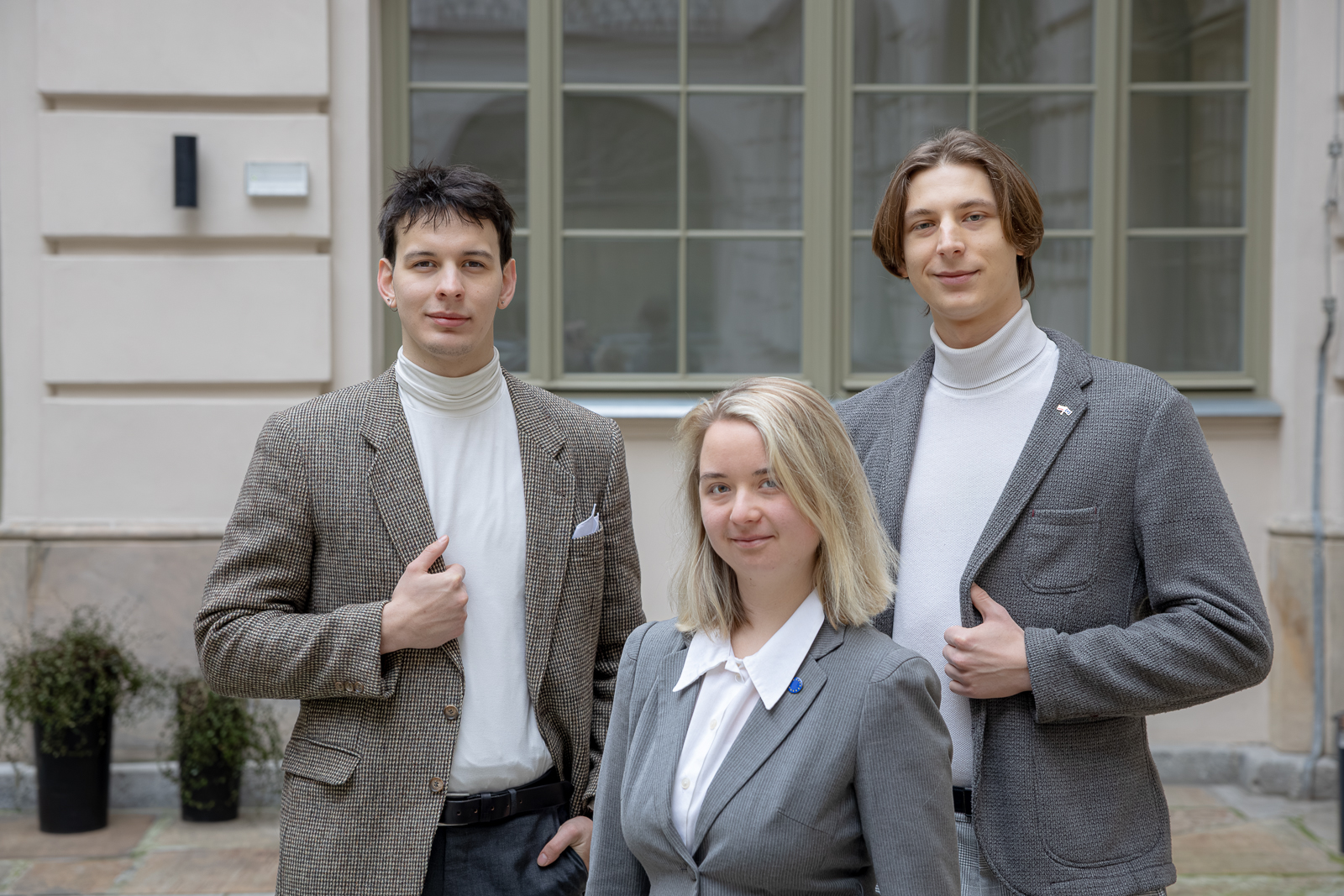
Our students in an international EU project ConSIMium
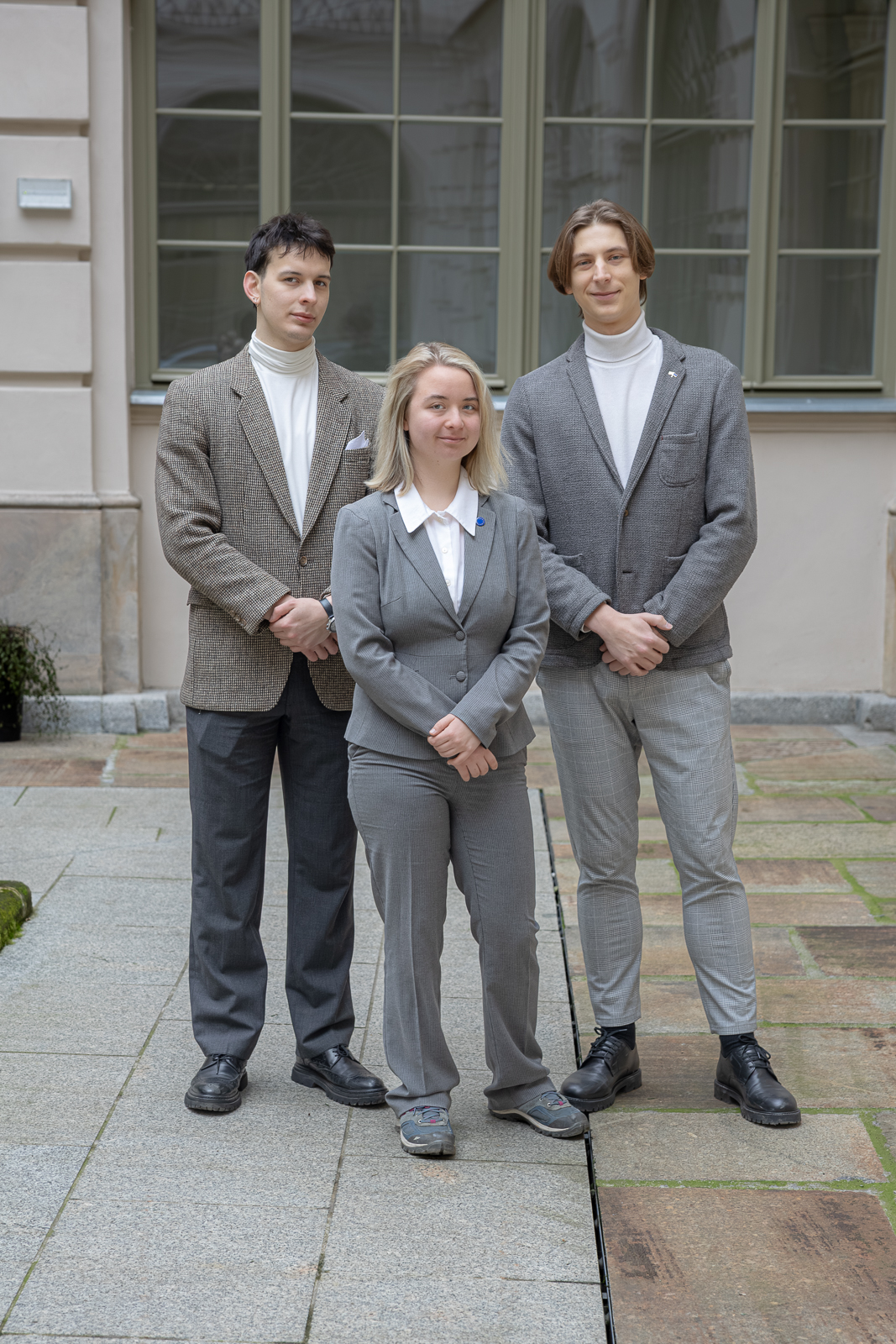
Three of our students, Natalia Zdziarska, Filip Szymański and Igor Jasiński, became members of the select team of six, which is to represent Poland in EU project ConSIMium. Qualified in the process of multistage recruitment, including the selection process carried by the university, the Conference of Rectors of Polish Universities and the Conference of Rectors of Academic Schools in Poland, they were chosen to participate in the European Council simulation. At the beginning of February, they will head to Brussels, where they are going to face the challenges of European diplomacy and decision-making process.
Read about their recruitment, preparations and expectations connected with the project.
Maria Kozan: Which year are you in and what do you study?
Filip Szymański: Together with Natalia, we’re in our Bachelor studies and we know each other by sight, as we both study in the Faculty of Social Sciences. I’m in my third year of European Diplomacy.
Natalia Zdziarska: And I’m in my third year of Migration Management at the Institute of European Studies.
Igor Jasiński: I’m in my fourth year. I study International Relations. During my Bachelor studies, I specialised in European studies and I am likely to choose the same specialisation during my Master studies.
MK: Did your studies or your participation in student scientific associations somehow help you prepare you to the participation in such international initiatives?
FS: I am a member of the Student Council and the Student Scientific Association Project Europe. I’m also a member of Rosa Luxemburg Scientific Circle of Leftist Thought. I believe that majoring in European Diplomacy is a great preparation for such an undertaking. In comparison with other international majors, it is really practical. For example, this semester, we are taking the course “International Negotiations”, which teaches crucial competences for projects such as ConSIMium. Also, as a student association, we meet with diplomats, take part in debates and international trips, and thus we learn many practical skills.
NZ: I’m a member of Student Scientific Association of Geopolitical Thought, Social Projects Management Research Club and Student Scientific Associations Council. As SSAGT, we did organise a model UN simulation, though I did not personally participate in this particular event.
FS: There is also a lot going on on EU Information Point. They organise debates, short model UN simulations, lectures and discussions.
IJ: I belonged to a student association, which was meant as a forum for dialogue, however, it operated for a year only and no longer exists. I was also a member of the Academic Sports Association. What I find most important is, however, my working experience. EU projects are what I work on everyday. The university, especially my specialisation, enables me to broaden my knowledge about how the EU works as a legislature and what the competences of particular institutions are. We also do a lot of public speaking at the University, including giving presentations or participating in classes run in the form of negotiations. A few of my colleagues even represented our University in a negotiation competition in Warsaw.
MK: How did you learn about the project ConSIMium?
FS: The information about the project was sent to all Faculty of Social Sciences students and promoted in the student scientific association. I was interested in this project as last year a student from our institute participated in it. Their team held presidency in the European Council, which was an interesting, but also very demanding role.
NZ: I learned about ConSIMium in September, when information about this year’s edition were first released. At the time I was on an exchange in the US, so at first I didn’t think I would be able to actually participate in it. But when I got a Teams notification about the application opportunities, I decided to give it a go. I was quite surprised to learn that I qualified to the next stage of recruitment, especially as due to the time difference I received an email in the middle of the night.
MK: How did the recruitment process look like?
FS: We had to prepare a cover letter, CV and a signed consent to participation. Only the students of the third year of Bachelor studies and the first year of Master studies could participate.
NZ: The organisers also took into account the average grade and the knowledge of foreign languages on the level B2+.
FS: And they checked who participated in the project in the previous years. The teams were more diverse at the time, for example, they included members from English Philology or Romance Studies. This year we all major in pretty similar fields.
NZ: Afterall, we are not sure why we were chosen. I know people who were strong candidates, but did not qualify.
FS: The criteria were really strict. The choice was based on the rules of diversity, we had to represent different geographical localisations, sex genders and majors. The group had to be maximally representative.
MK: Do you have contact with the members from other universities?
FS: Yes. We know that there are people from Mazury or Warsaw in our team. What connects us is our engagement and the willingness to truly prepare for the simulations. We already started to work on first documents.
MK: What exactly is ConSIMium, and what do the workshops look like?
FS: I will be a minister.
NZ: And I will be one of the two national experts.
IJ: I will be a journalist. I will be interviewing the ministers and experts.
FS: Each group consists of six people and five roles. For two intensive days we participate in the simulation of a full decision process in the European Council. All the problems and documents we work on are authentic and were discussed by the real ministers, ambassadors and experts before. Each working day starts early and is filled with activities with technically no breaks. It is a great opportunity to see how the European Union arrives at decisions. Interestingly, the solutions prepared during the simulation often differ drastically from those eventually chosen by the EU.
NZ: It is because students and the real decision-makers think differently.
MK: Do you have a supervisor from the University during the workshops?
FS: We are supervised by Dr. Marcin Mrowicki, but he mostly offers us organisational support. We are fully responsible for all we do during the simulations.
MK: And how do you divide work during the simulation?
NZ: Firstly, the national experts make basic decisions about the documents. Then, during the COREPER meetings, ambassadors decide about the details. The final propositions are voted on by the ministers
FS: It is crucial that we as representants of the same country keep a unified stance on the problem. I cannot suddenly take a stance which is radically different from the one that was presented by my team before.
MK: The project certainly requires rhetorical and persuasive skills, as well as openness to the arguments and perspectives of others. Do you plan to work in a similar field in the future?
NZ: Currently I’m more focused on the most immediate future. I’d like to begin my Master’s Studies in European Diplomacy at the University of Wrocław. I’m not sure what I’m going to do in the future. Perhaps I’ll begin Doctor studies.
FS: Just like Natalia, for now I would like to focus on finishing my Master’s studies. I am not yet sure what I am going to do in the future, but I would like to keep developing in the fields of international policy, diplomacy and European studies, most likely at our faculty. I’m considering the job in civil service or some international organisation as this kind of job seems most appealing to me.
IJ: Honestly, I’m considering different options. I currently have two jobs, one of them is connected with the environment and waste processing. That is why I have certain experience and I know how dynamically European institutions work in this field. Do I want to have such a job in the future? I am not sure, but it is possible. And who knows – perhaps one day I will be working in Brussels.
MK: What are your reflections about the project ConSIMium? Was it worth participating?
NZ: It is definitely worth trying. Even the mere possibility of participating in such an event is something wonderful. 27 countries organise an event for young people to teach them dialogue and peaceful cooperation. It is a truly unique experience.
FS: And even if you take a clearly practical perspective, it is a real opportunity. You can spend two days in Brussels, in the European Council’s headquarters, which are normally a restricted area, and the EU covers all costs. But it is just one of the reasons why it is worth participating. What is most important is that you can take part in the European Council simulation and when you’re a part of this process, you come to understand how the crucial decisions influencing our lives are made. In this way, we increase our political consciousness and become more aware of different factors impacting the final decisions.
Translated by Julia Wdowiak (student of English Studies at the University of Wrocław) as part of the translation practice.
Date of publication: 29.01.2026
Added by: M.K.


