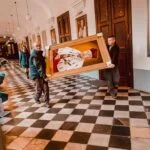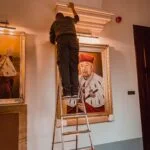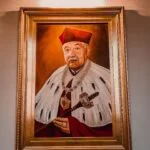

Rector Adam Jezierski’s portrait in the rector’s corridor
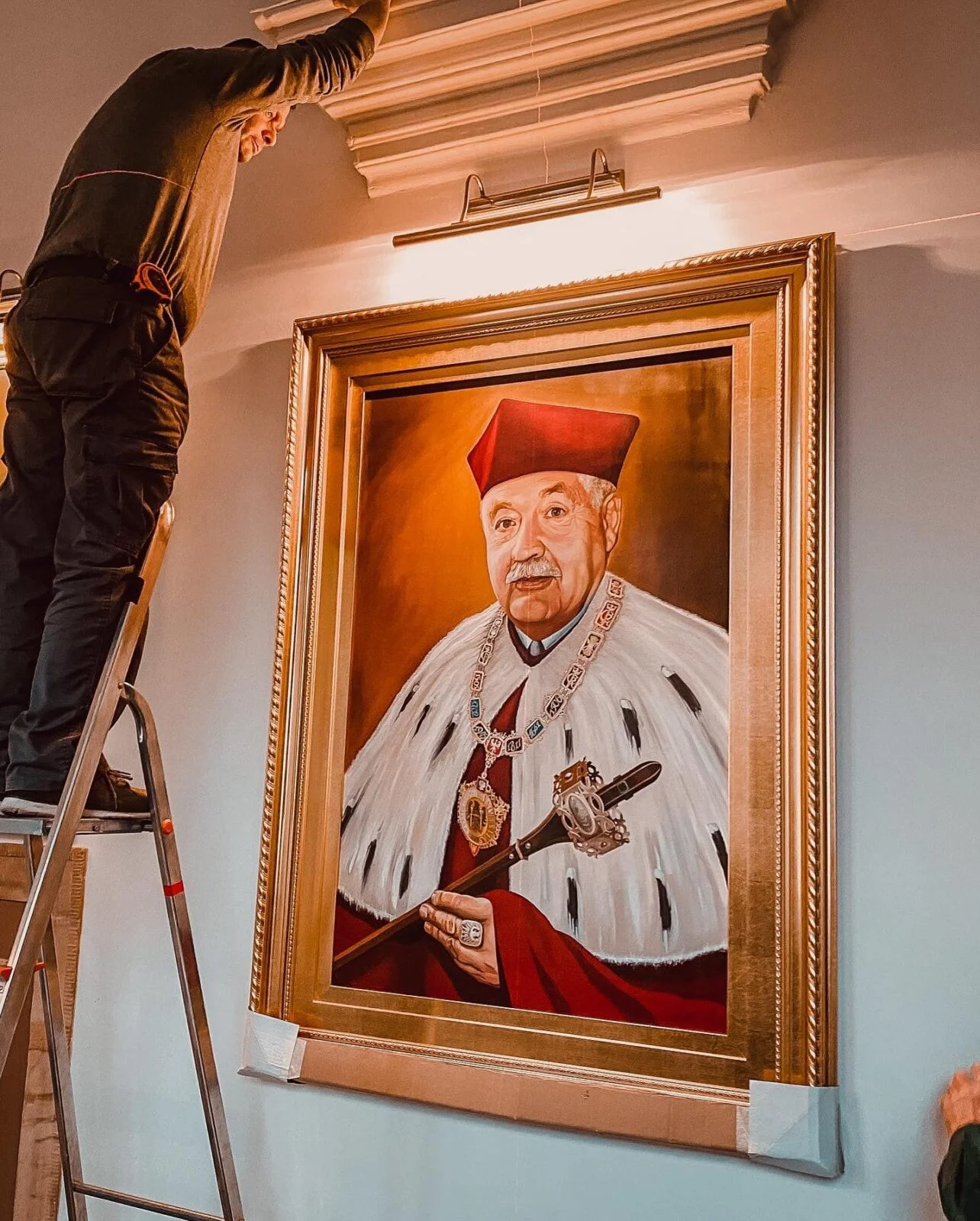
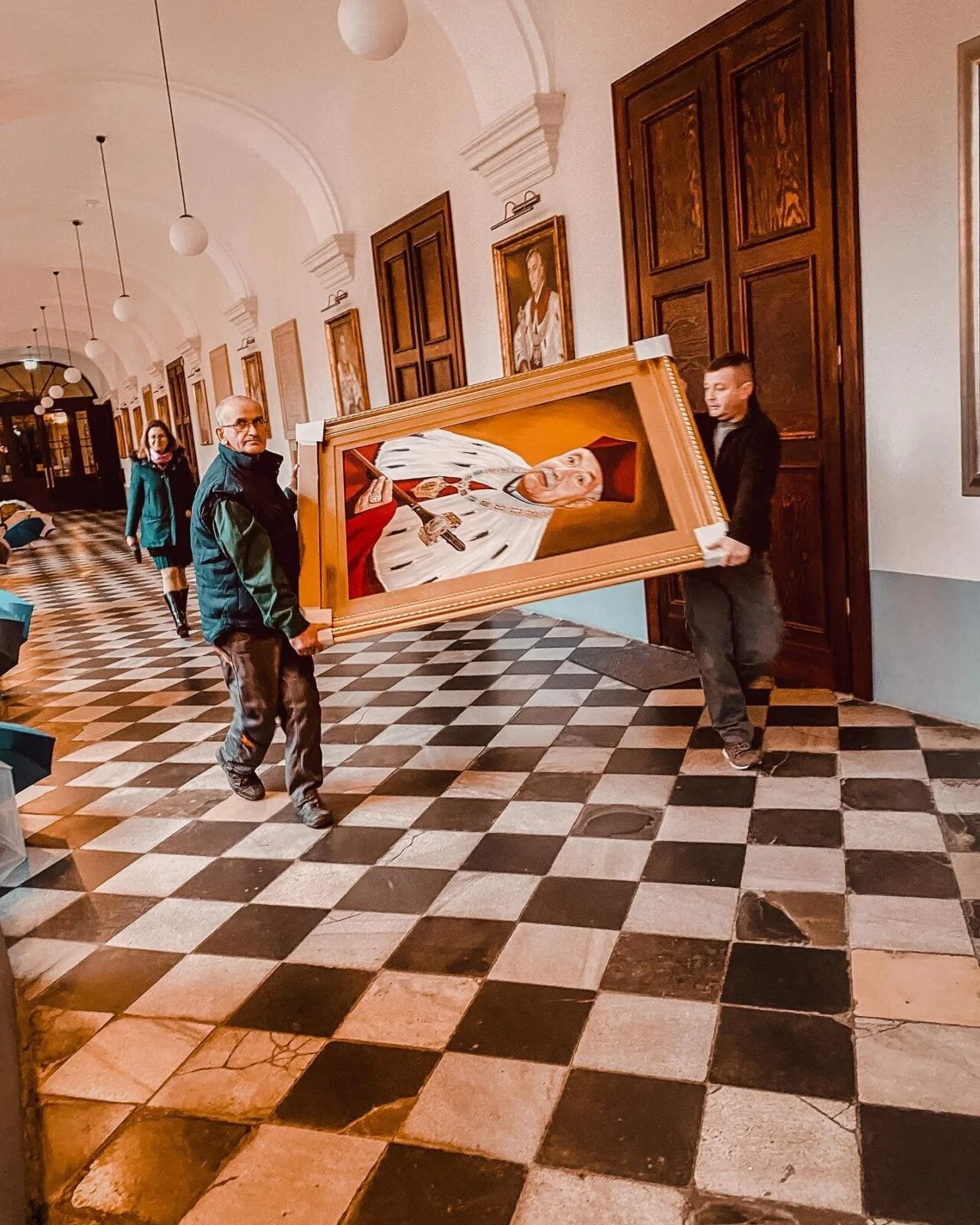
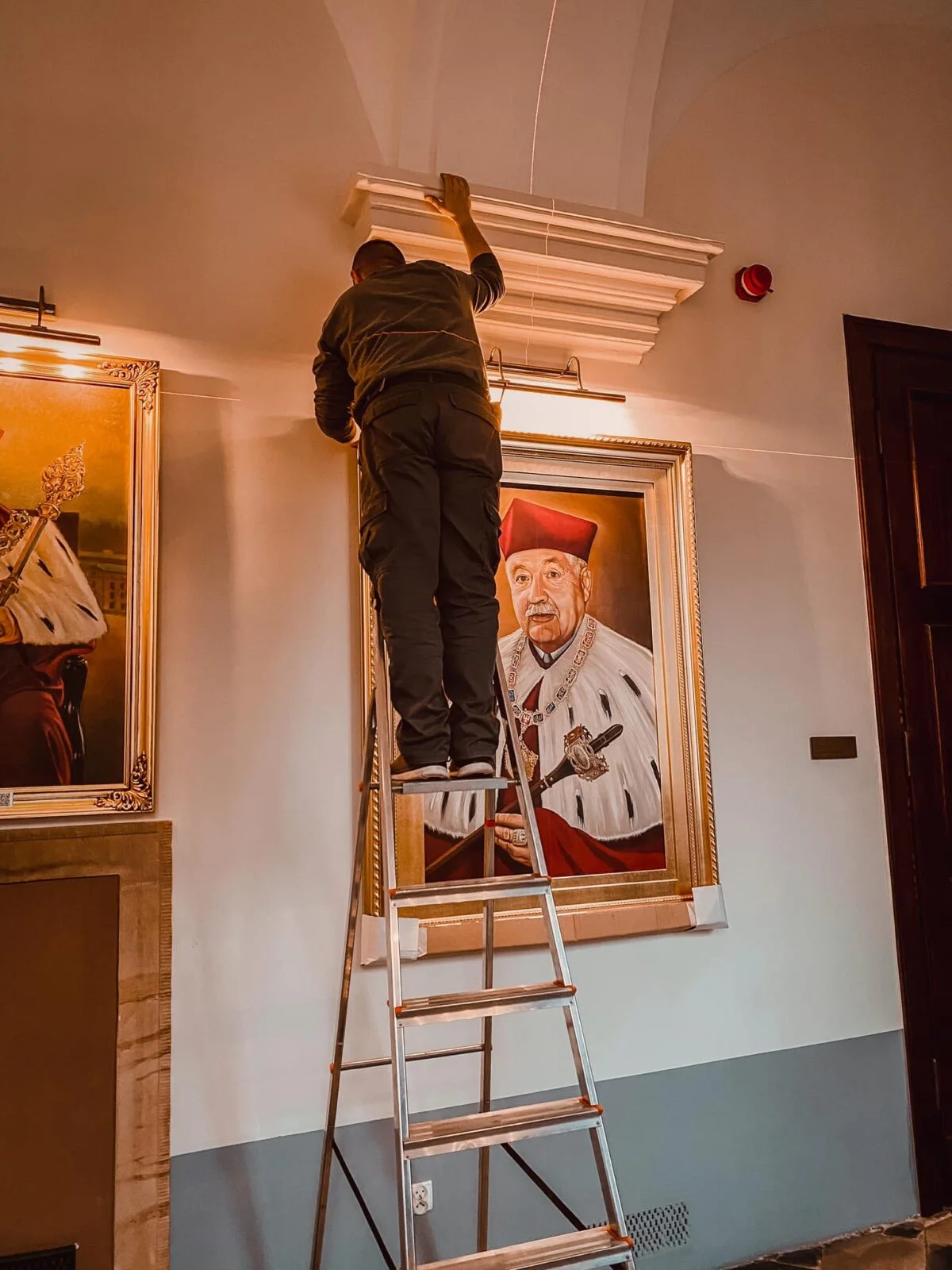
Professor Jezierski was a rector of the University of Wrocław in the years 2016-2020. His portrait was hung in the corridor connecting the Rector’s Office with Aula Leopoldina on 6th December 2022. Painted by Marek Cajdler, it is the 20th painting in the rectors’ portraits gallery. You can see it on the first floor of the main building of the University of Wrocław.
Tradition since the post-war times
It is a tradition of our University that when a new rector’s term begins, the Senate of the University of Wrocław accepts the new rector’s request for ordering a portrait of his predecessor. Usually, it is the subject of the portrait who chooses the painter and settles down all the details. Nevertheless, most of the rectors choose to be depicted in similar, noble attire; sitting on a rector’s chair, dressed in red rector’s gowns and white ermine coats, carrying the attributes of rector’s power – a chain, a sceptre and a ring. Our gallery proudly keeps up to world-class university standards. However, there is one painting which differs from the others. It is a portrait of Professor Leszek Pacholski, Rector of the University in the years 2005-2008, painted by Leszek Żegalski (a follower of Jerzy Duda-Gracz, Professor’s favourite painter). In the painting, Professor Pacholski is wearing an unbuttoned short-sleeve shirt, his rector’s gown carelessly tossed over his forearm. This seems to be an unprecedented case in the history of rector galleries around the world.
Another very special painting in the gallery is a portrait of Rector Professor Marek Bojarski. He is depicted on the background of Lviv panorama. Why? It is because the history of the University of Wrocław is closely connected with this city and the ex-Rector was felt a particular affiliation with it. This is where his parents got married in the cathedra (which can be seen in the painting) and his father finished his legal studies. The picture was painted by Wojciech Kotlewski.
The rectors’ insignia
In the picture, Rector Professor Adam Jezierski is wearing traditional rector’s attire: a red rector’s gown with white, spotted collar, a red biretta and a chain. He’s holding a sceptre and has a ring on his finger. The sceptre, as we are always reminded in a traditional formula recited by the rector on giving the insignia over to their successor, is a symbol of the rector’s power, while the chain stands of the dignity of their office. The ring has a nuptial character. It is worn on a ring finger of right hand to manifest the connection of the rector with the university.
As did his predecessor, Rector Professor Marek Bojarski, Rector Professor Adam Jezierski used the sceptre and the ring from the year 1968, but wore the rector’s chain which was first used by Edward Marczewski during the inauguration of the academic year 1956/1957. The chain is often used as its symbolic ornaments tell the long history of the University of Wrocław. It was designed in 1956 by a host Wrocław from the years 1949-1990 (halves of the Silesian and Polish eagles, brought together in one). Above the placard, there are two crossed rector sceptres. Links on both sides of the central placard are decorated with dates and symbols. A number of them allude to the fact that the original, post-war staff of the University included mostly professors from Lviv. An inscription “1661” stands for the foundation date of the University of Lviv, whose founder was commemorated in the letters ICR (Ioannes Casimirus Rex) entwined with the links with sheaves of grain (symbol of his dynasty).
On other links, there are inscriptions with dates of important events from the University history: 1505 – the first, unsuccessful attempt of founding a university in Wrocław; 1506 – the foundation of the Viadrina University in Frankfurt by the Odra River; 1702 – the foundation of the Jesuit Leopoldian Academy in Wrocław; 1811 – the fusion the two universities into a single state university in Wrocław; 1945 – the end of the 2nd World War and the opening of the Wrocław University as a Polish institution.
The chain is connected with an openwork medal (80mm in diameter) with the eagle of Lower-Silesian Piasts, with a characteristic sash on its breast and two rector sceptres in its claws. Its rim is decorated with the inscription UNIVERSITAS WRATISLAVIENSIS. The top of the medal is decorated with the emblem of Poland (a crowned eagle, which replaced the original uncrowned one when the emblem was altered), while on the bottom part of the medal, there is a placard with a letter W (an element of a historical emblem of Wrocław).
The ring and the sceptre you can see in the portrait of Rector Jezierski were gifted to the University by the Lower Silesian Chamber of Crafts. The sceptre is 90 cm long. It is a hexagonal staff, finished in a hexagonal, goblet-like platform decorated with polished ellipsoid gems. The ring, which is worn by the rector during all the official events, has a square plate with the Silesian Eagle.
Who is Professor Adam Jezierski?
Prof. dr hab. Adam Jezierski (born in 1948) is a chemist. He earned his Master’s degree in Chemistry in 1970, at the Faculty of Mathematics, Physics and Chemistry. It was soon followed by a doctorate (1978) and habilitation (1986). In 1995, he became a professor of Chemistry and since 2000 he is a full professor. In the years 1990-1996, he was a vice-dean of the Faculty of Mathematics, Physics and Chemistry. He remained inn this position when it was turned into the Faculty of Chemistry and became its vice-dean again in the years 1999-2005. In 2008 he held a function of Vice-Rector for Research and International Cooperation. He was elected the rector of the University of Wrocław for the rector’s term 2016-2022.
He specialises in inorganic physiochemistry and molecular spectroscopy. He is interested in chemical changes of the organic matter in the environment and, in particular, in waste disposal, free radicals chemistry and the role of heavy metals and other xenobiotics in the natural environment. He also researches the use of magnetic resonance and electron paramagnetic spectroscopy resonance (EPR) for investigation of the impact of chemical and biological factors on cell membranes and the use of new biodegradable surface active agents (surfactants). The methods he uses and created enable quick and effective monitoring of the quality and changes of the organic matter and living creatures in the natural environment, on the basis of free radical reactions.
Professor Jezierski cooperates with numerous foreign research centres, participating in research programmes and international conferences. He is an author of many books and articles in international journals. He gave lectures at universities in Great Britain, Germany, Italy, Russia and China. He is a co-organiser of Interdisciplinary Seminar Studium Generale Universitatis Wratislaviensis, established in 1992, and an editor of the Studium’s series of publications. He also works actively for the popularisation of science. In the years 2015-2020 he was a member of CHR Monitoring Committee for Lower Silesia.
Professor Jezierski enjoys mountain trips in the Sudetes, as well as cycling in the surroundings of Wrocław. He is an admirer of baroque and romantic music. He himself plays the piano and the organ, mostly for the visitors and the old workers of the University of Wrocław. Professor Jezierski reads and tries to understand books on the history of philosophy, but appreciates also Polish poetry of the 19th and 20th centuries and books by Stanisław Lem, which provide him with optimism in the difficult moments.
The rectors’ portraits in the gallery are arranged in chronological order. Here is the list of paintings you see as you go from the rectorate:
Rector’s term 1945-1951
Rector Stanisław Kulczyński
Painter: Antoni Michalak (1902-1975), painted in 1949
Rector’s term 1951-1953
Rector Jan Mydlarski
Stanisław Pękalski (1895-1967), 1957
Term 1953-1957
Rector Edward Marczewski
Stanisław Pękalski (1895-1967), 1958
Rector’s term 1957-1959
Rector Kazimierz Szarski
Eugeniusz Geppert (1890-1972), 1960
Rector’s term 1959-1962
Rector Witold Świda
Stanisław Pękalski (1895-1967), 1962
Rector’s term 1962-1968
Rector Alfred Jahn
Antoni Michalak (1902-1975), 1974
Rector’s term 1968-1971
Rector Włodzimierz Berutowicz
Antoni Michalak (1902-1975), 1974
Rector’s term 1972-1975
Rector Mariusz Orzechowski
Władysław Kamiński (1912-1993), 1979
Rector’s term 1975-1981
Rector Kazimierz Urbanik
Ryszard Jędrak (1927-1991), about 1990
Rector’s term 1981-1982
Rector Józef Łukaszewicz
Ryszard Jędrak (1927-1991), about 1990
Rector’s term 1982-1984
Rector Henryk Ratajczak
Teresa Buczyńska (born 1941), about 2009
Rector’s term 1984-1987
Rector Jan Mozrzymas
Marek Wałęga, 1992
Rector’s term 1987-1990
Rector Mieczysław Klimowicz
Andrzej Klimczak-Dobrzaniecki (1946-2020), 1992
Rector’s term 1990-1995
Rector Wojciech Wrzesiński
Andrzej Klimczak-Dobrzaniecki (1946-2020), 2001
Rector’s term 1995-1999
Rector Roman Duda
Teresa Buczyńska (born 1941), about 2007
Rector’s term 1999-2002
Rector Romuald Gelles
Teresa Buczyńska (born 1941), ok. 2009
Rector’s term 2002-2005
Rector Zdzisław Latajka
Teresa Buczyńska (born 1941), about 2007
Rector’s term 2005-2008
Rector Leszek Pacholski
Leszek Żegalski (born 1959), 2010
Rector’s term 2008-2016
Rector Marek Bojarski
Wojciech Kotlewski (born 1941), 2013
Rector’s term 2016-2022
Rector Adam Jezierski
Marek Cajdler, 2022
Translated by Julia Wdowiak (student of English Studies at the University of Wrocław) as part of the translation practice.