
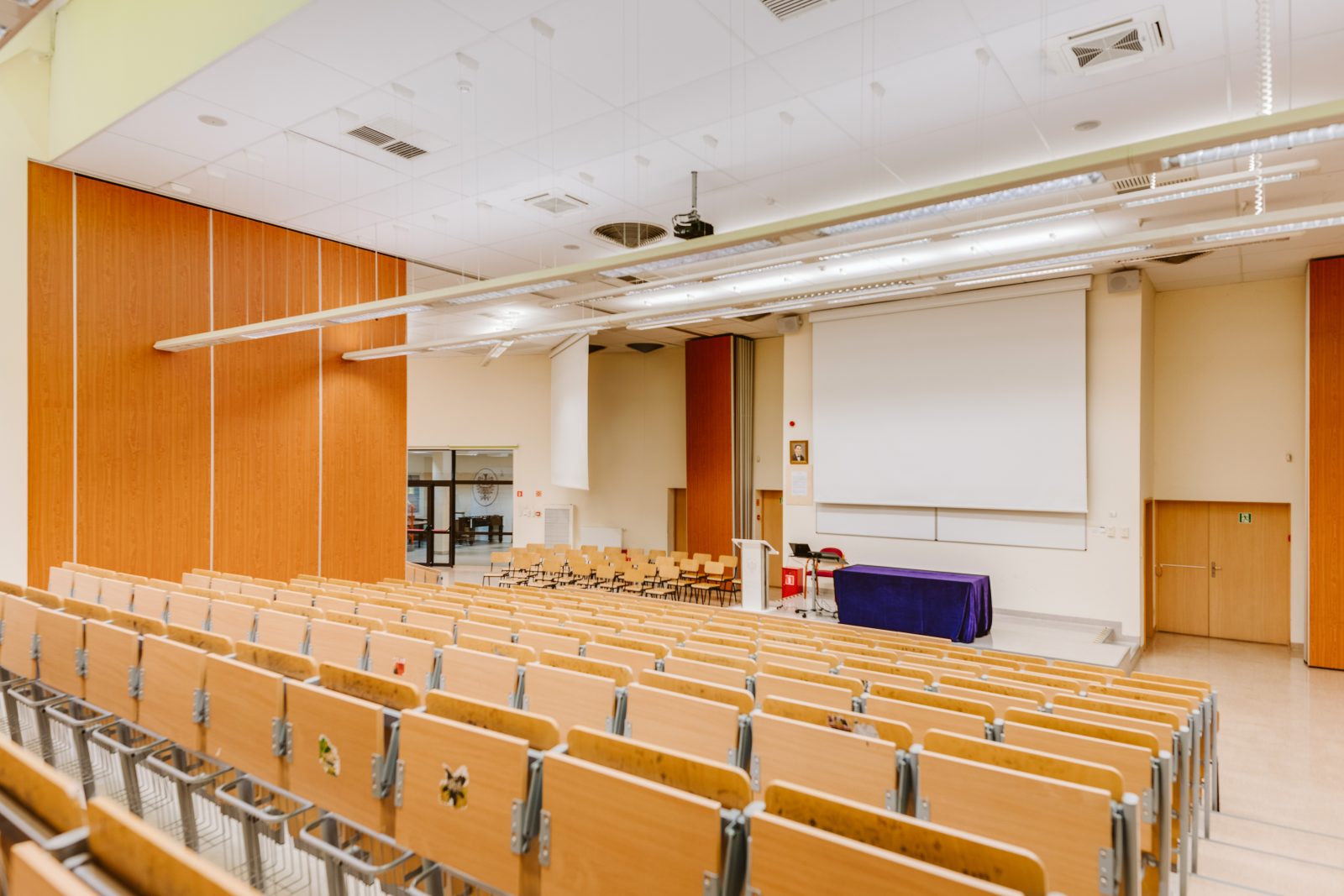
sala wykładowa
photo: Magdalena Marcula

Two eminent philosophers to visit University of Wrocław – thanks to IDUB

The Institute of Philosophy invites you to two open lectures by eminent foreign researchers, held as part of the “Excellence Initiative – Research University” (IDUB) programme. In the coming days, University of Wrocław will host prof. Gregory Reichberg from Norway and prof. Mark Cherry from the United States. Both presentations will be devoted to current and vital philosophical issues related to personal identity, human embodiment, and artificial intelligence.

Prof. Gregory Reichberg’s Lecture

The lecture titled “Interpreting Artificial Intelligence in a Thomistic Frame” will take place on 18 March at 2:00 PM in room 135 of Instytut Filozofii (ul. Koszarowa 3/20, Wrocław).

Prof. Gregory Reichberg, a researcher associated with the Peace Research Institute Oslo, will discuss contemporary problems related to artificial intelligence from a Thomistic perspective. In his presentation, he will address the philosophical and ethical aspects of AI development, referring to the classical thought of St. Thomas Aquinas.

Prof. Mark Cherry’s Lecture

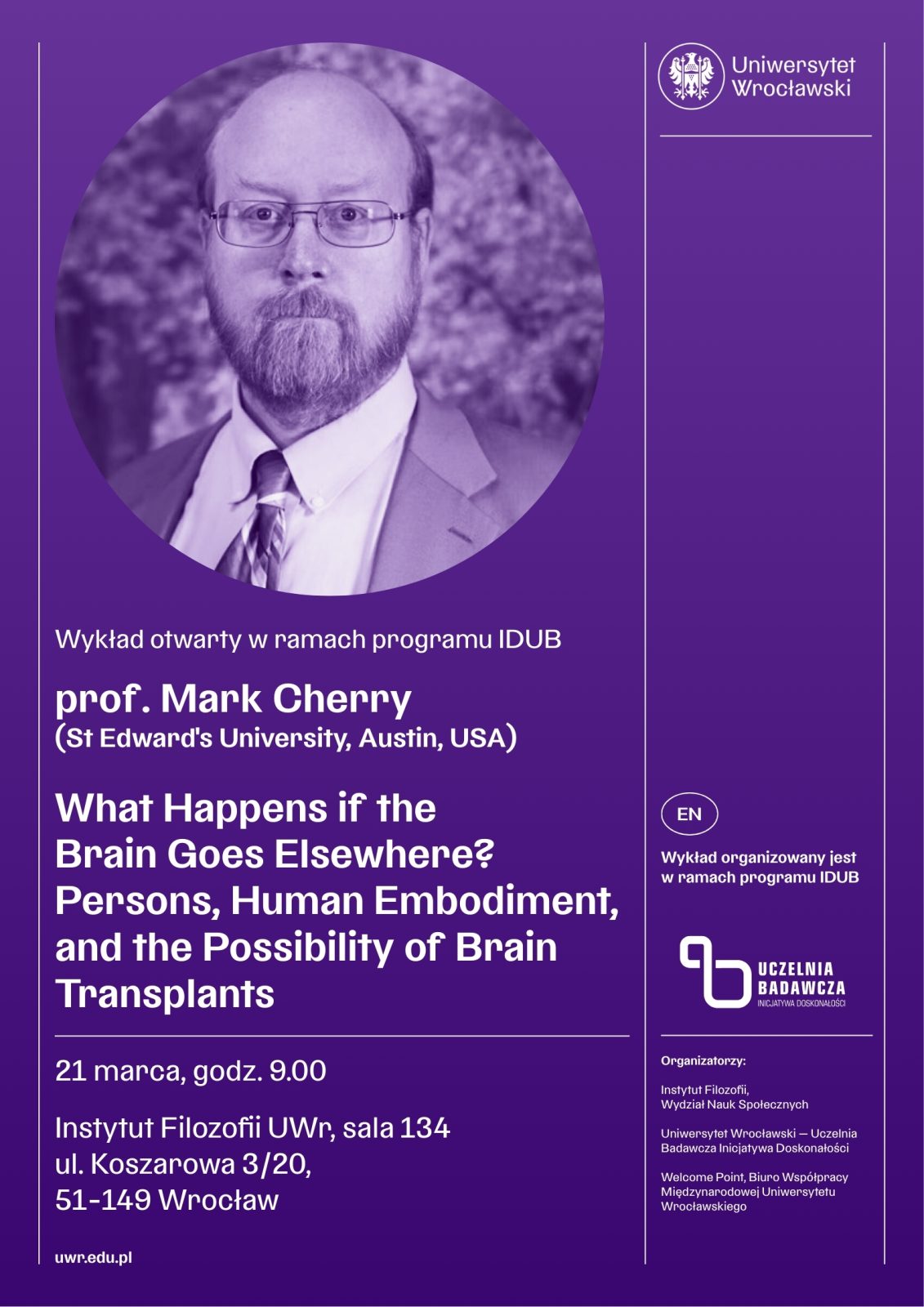
The second lecture will take place on 21 March at 9:00 AM, in room 134 of the same building. Lecture title: “What Happens if the Brain Goes Elsewhere? Persons, Human Embodiment, and the Possibility of Brain Transplants”

Prof. Mark Cherry from St. Edward’s University in Austin will explore the topic of personal identity and the boundaries of human embodiment in the context of hypothetical brain transplants.

Both lectures will be conducted in English. We particularly invite those interested in ethics, the philosophy of artificial intelligence, and the consequences of future technological and medical challenges.

Translated by Hanna Jordanek (student of English Studies at the University of Wrocław) as part of the translation practice.
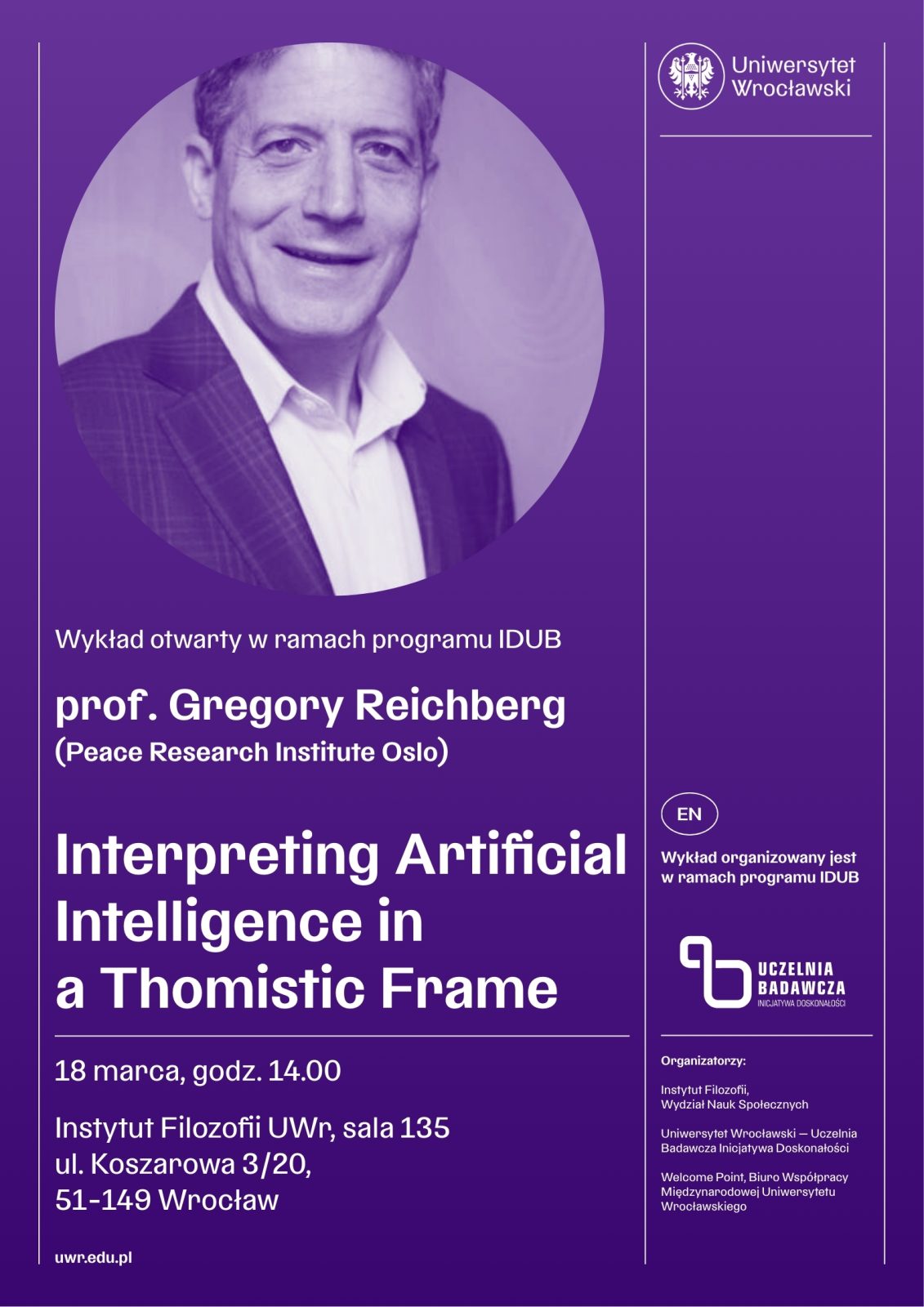
Fioletowy plakat zapowiadający wykład otwarty w ramach programu IDUB na Uniwersytecie Wrocławskim. Po lewej stronie znajduje się zdjęcie osoby w formalnym stroju — w marynarce i koszuli — ujętej od klatki piersiowej w górę. Zdjęcie jest wkomponowane w fioletowe tło graficzne.
Po prawej stronie umieszczono logo Uniwersytetu Wrocławskiego.
Poniżej zdjęcia znajduje się tekst informacyjny:
Wykład otwarty w ramach programu IDUB
prof. Gregory Reichberg (Peace Research Institute Oslo)
Dużym białym fontem zapisano tytuł wykładu:
Interpreting Artificial Intelligence in a Thomistic Frame
Niżej podano szczegóły wydarzenia:
18 marca, godz. 14.00
Instytut Filozofii UWr, sala 135, ul. Koszarowa 3/20, 51‑149 Wrocław
uwr.edu.pl
Po prawej stronie widnieje pionowy napis:
EN — Wykład organizowany jest w ramach programu IDUB,
a pod nim logo „Uczelnia Badawcza”.
Na dole zamieszczono listę organizatorów: Instytut Filozofii, Wydział Nauk Społecznych, Uniwersytet Wrocławski oraz Institute of Peace Research (Oslo).
Fioletowy plakat zapowiadający wykład otwarty w ramach programu IDUB na Uniwersytecie Wrocławskim. W górnej części po lewej stronie znajduje się zdjęcie osoby w eleganckim stroju — w marynarce, koszuli i krawacie — ujętej od klatki piersiowej w górę, umieszczone w okrągłej ramie.
Po prawej stronie widnieje logo Uniwersytetu Wrocławskiego.
Pod zdjęciem znajduje się tekst:
Wykład otwarty w ramach programu IDUB
prof. Mark Cherry (St Edward’s University, Austin, USA)
Dużym, białym fontem zapisano tytuł wykładu:
What Happens if the Brain Goes Elsewhere? Persons, Human Embodiment, and the Possibility of Brain Transplants
W dolnej części plakatu podano szczegóły wydarzenia:
21 marca, godz. 9.00
Instytut Filozofii UWr, sala 134
ul. Koszarowa 3/20, 51‑149 Wrocław
uwr.edu.pl
Po prawej stronie znajduje się pionowy napis EN – Wykład organizowany jest w ramach programu IDUB oraz logo „Uczelnia Badawcza”.
Na dole umieszczono listę organizatorów: Instytut Filozofii, Wydział Nauk Społecznych Uniwersytetu Wrocławskiego oraz współorganizatorów afiliowanych przy Uniwersytecie.

Date of publication: 13.03.2026

Added by: EJK

Projekt „Zintegrowany Program Rozwoju Uniwersytetu Wrocławskiego 2018-2022” współfinansowany ze środków Unii Europejskiej z Europejskiego Funduszu Społecznego

Scroll to Top