



Faculty of Physics and Astronomy
The faculty comprises three research units: the Astronomical Institute, the Institute of Experimental Physics, and the Institute of Theoretical Physics. In addition, as part of the „Excellence Initiative – Research University” project, two Incubators of Scientific Excellence are in operation: Solar and Stellar Activity and the Center for Superdense Fluid Simulations. The faculty conducts research in astrophysics, heliophysics, space weather, solid-state physics, nanomaterial physics, dielectric physics, nuclear physics, cosmology, the theory of gravity, mathematical methods in physics, field theory, the theory of elementary particles, fundamental interactions and nonlinear systems.
The academic disciplines pursued at the faculty —astronomy and physical sciences— have been awarded Category A for quality of research. The research projects are funded largely by national and European grants. Some of the research is conducted in collaboration with, among others, CERN, the Institute of Low Temperature and Structural Research of the Polish Academy of Sciences, the Łukasiewicz Research Network – PORT and the Space Research Center of the Polish Academy of Sciences.
ASTRONOMICAL INSTITUTE
Research is conducted in two departments:
- Department of Heliophysics and Space Physics (DHSP)
- Department of Astrophysics and Classical Astronomy (DACA)
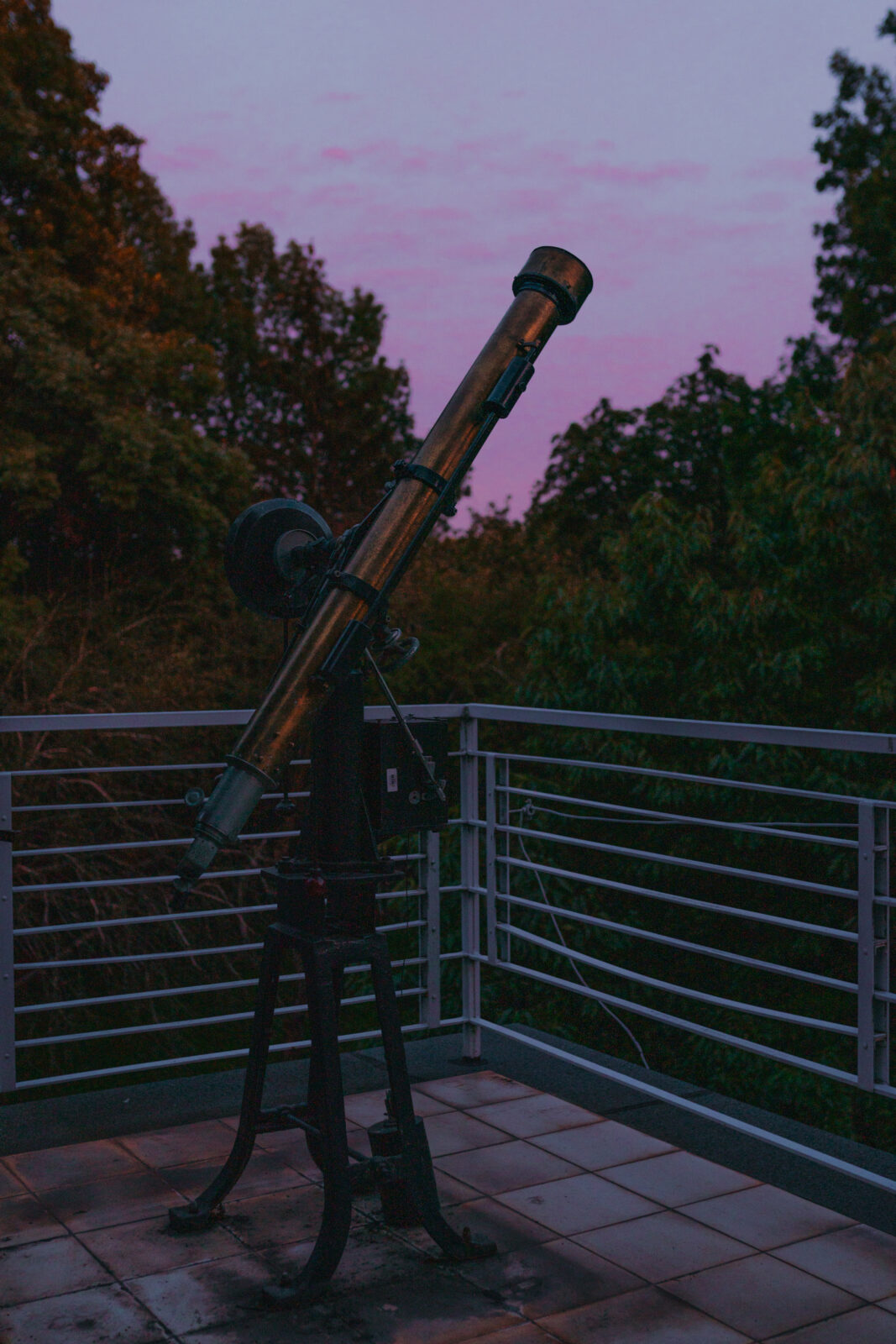
Astrophysicists at the Department of Astrophysics and Classical Astronomy focus primarily on variable stars, which they study using methods known as asteroseismology, a technique that allows them to “peek” inside these stars to understand their structure and evolution. The Wrocław astrophysicists have at their disposal a 60-cm Cassegrain telescope equipped with a professional CCD camera, sets of photometric filters, and an automatic telescope guiding system (autoguider). Work is currently underway to commission a 12.5-inch Ritchey-Chrétien telescope from the American company RC Optical Systems, which will be remotely controlled. These instruments are located at the observation station in Białków. In their research, astrophysicists also make use of large-scale photometric surveys of the sky (OGLE, Gaia, SDSS) and satellite observations (Kepler, TESS).
Research topics include:
- asteroseismology of pulsating stars of early spectral types;
- photometric variability of stars: identification of oscillation modes, modeling of stellar atmospheres;
- study of star clusters (open and globular);
- search for variable stars in our own observations, satellite data, and large-scale photometric surveys;
- stellar spectroscopy and spectral synthesis;
- determination of binary star parameters.
The focus of research by heliophysicists at the Department of Heliophysics and Space Physics is, of course, the Sun, and in particular the active phenomena occurring in all layers of its atmosphere that are associated with changes in the structure of the magnetic field, such as solar flares, coronal mass ejections, coronal holes, solar prominences, and radio bursts. This research is conducted using specialized observational instruments, including the 53-cm Large Coronagraph, the 15-cm Horizontal Telescope with a 30-cm Jensch celostat, and the MSDP spectrograph, all located at the observation station in Białków. The heliophysicists also use the experience they have gained to study similar phenomena occurring on other magnetically active stars. In their scientific work, they also frequently utilize satellite observations (SDO, IRIS, Solar Orbiter, Kepler, TESS).
Research topics include:
- detailed interpretation of various phenomena observed in the solar corona;
- monitoring of energy release and particle acceleration in solar flares;
- verification of the mechanisms responsible for heating the solar corona;
- modeling of processes occurring in the active solar atmosphere;
- systematic description of the properties of solar prominences;
- comprehensive study of stellar flare parameters.
INSTITUTE OF EXPERIMENTAL PHYSICS
Research is conducted in five departments:
- Department of Nuclear Physics and Dielectrics (DNPD),
- Department of Surface Physics and Nanostructures (DSPN),
- Department of Nanooptics and Nanostructures (DNN),
- Department of Physics Education (DPE),
- Department of Electron Spectroscopy (DES), which includes the EC-STM9 Group.
Researchers at the Department of Nuclear Physics and Dielectrics conduct research on the following topics:
- corrosion and thermodynamics of iron-containing alloys;
- processes of formation and evolution of structural defects in minerals, resins, polymers, amorphous materials, metal alloys, and organic compounds;
- superconductivity and magnetism in bulk materials and nanoparticles;
- sodium-ion batteries;
- properties of ferroelectric and ferroelastic crystals, with particular emphasis on structural phase transitions.
Research conducted at the Department of Surface Physics and Nanostructures is theoretical in nature and based on first-principles calculations, most of which utilize density functional theory. These calculations are performed using either a plane-wave basis set or a basis set of localized pseudo-atomic orbitals. The research focuses on the structural and electronic properties of metals and semiconductors, as well as their surfaces. It covers a wide range of processes occurring on these surfaces, such as adsorption, surface diffusion, the formation of oxidized layers, and the formation of ordered low-dimensional structures and molecular assemblies. Various possibilities for modifying the chemical reactivity of semiconductor surfaces are being investigated in order to initiate the ordered aggregation of diffusing atoms in the form of nanostructures with specific geometric and electronic properties. Research conducted at DSPN also concerns the formation and properties of two-dimensional spin-polarized electron gas in multilayer systems in the context of potential applications in electron spin transport. The scientific profile of the DSPN also includes the study of electron transport in non-equilibrium systems (e.g., under scanning tunneling microscopy [STM] conditions) as well as dynamics and molecular electronics. The theoretical research conducted at the Department draws on scientific data collected by experimental groups based on measurements performed using techniques such as STM, STS, LEED, XPS, and ARPE.
The staff at the Department of Nanooptics and Nanostructures conduct extensive research in the field of surface physics. Their work focuses in particular on phenomena associated with adsorption and occurring in thin-film systems (crystal nucleation and growth, structural evolution under varying temperatures, including surface diffusion, intercalation, faceting, segregation, thermal desorption, changes in surface reconstruction), as well as the determination of the structural, electronic, and physicochemical properties of solid surfaces at the nanometer and subnanometer scales. The emission properties of the fabricated systems are also studied. With a view to practical applications, methodologies for fabricating thin-film systems with specific physicochemical properties are also being developed.
The Department of Physics Education conducts research in the broadly defined field of physics education. This research focuses in particular on issues related to multimedia support for teaching and learning physics, as well as the role of history and methodology in the training of physics teachers. At the same time, the Department’s staff conduct and participate in work on the development and modernization of physics curricula at various stages of education, as well as on the development of concepts and the implementation of changes in the professional training of future physics teachers. An equally important activity of the DPE is the education of students—future physics teachers. As part of the program preparing students for the teaching profession, the Department’s staff provide instruction in the fundamentals of pedagogy and subject-specific pedagogy. In addition, the DPE supports the professional development of active physics and science teachers at various educational levels. It also undertakes numerous initiatives aimed at increasing interest in physics and promoting physics and physics studies among school students.
The experience of the staff members of the Department of Electron Spectroscopy is backed by a track record of scientific achievements in their respective research fields, as evidenced by a series of publications in renowned scientific journals, participation in national (NCN, IDUB) and international (AvH, DAAD, EU) guest lectures at international scientific conferences, and at research institutes. Researchers at DES have broad expertise, as well as experience in the construction and operation of scientific research equipment, and qualifications acquired both domestically and through research internships at numerous foreign research centers. In addition, the Department’s staff have many years of experience in research and development (R&D) through their positions at WCB EIT+ and Łukasiewicz PORT centers.
The research conducted at the DES focuses on the physicochemical properties of solid surfaces in ultra-high vacuum (UHV) and electrochemical (EC) environments. The Department houses laboratories equipped with high-vacuum apparatus, as well as an electrochemical laboratory. In addition to basic research, the Department also conducts applied research.
Research topics include:
• chemical composition of the surface and near-surface layers of solids (metals, semiconductors, oxides, two-dimensional materials);
• adsorption and determination of the growth mechanism of adsorbates (metals, semiconductors, inorganic and organic molecules);
• structure (short-range and long-range) of surfaces, near-surface layers, and adsorbate layers;
• desorption and thermal stability of adsorbates;
• surface morphology at the nanometer scale;
• liquid-solid and gas-solid phase systems;
• electrochemical oxidation and reduction (RedOx) reactions;
• deposition of metal ions and molecules from solutions onto the surfaces of single-crystal electrodes.
INSTITUTE OF THEORETICAL PHYSICS
Research is conducted in five departments:
- Department of Particle Physics and Nuclear Astrophysics (DPPNA)
- Department of Neutrino Physics (DNP)
- Department of Applied Computer Science and Statistical Physics (DACSSP)
- Department of Mathematical Methods in Physics (DMMP)
- Department of Gravitational Theory and Fundamental Interactions (DGTFI)
Scientists at the Department of Particle Physics and Nuclear Astrophysics conduct research aimed at describing the physical phenomena occurring in dense matter composed of strongly interacting particles. Such systems are the subject of intensive experimental research involving ultra-relativistic heavy-ion collisions at CERN in Geneva, at the Brookhaven National Laboratory (BNL), and at the GSI Heavy Ion Research Laboratory in Darmstadt. The primary goal of this research is to describe the properties of dense nuclear matter and a new state of matter called quark-gluon plasma, predicted by the theory of Quantum Chromodynamics (QCD). Another way to study matter under extreme conditions is to observe compact astrophysical objects such as supernovae or neutron stars.
Research topics:
– the physics of ultra-relativistic heavy-ion collisions;
– the physics of degenerate stars and supernovae;
– quantum field theory under extreme conditions.
Researchers at the Department of Neutrino Physics are involved in the international neutrino experiments T2K and Icarus. They are also working on theoretical models of neutrino interactions with other particles.
Research topics:
– study of neutrino interactions with nuclei and nucleons in the 1GeV energy range;
– development of the NuWro Monte Carlo simulator;
– study of nucleon form factors;
– statistical data analysis.
Researchers at the Department of Applied Computer Science and Statistical Physics focus on modeling the dynamics of complex physical, biological, and economic systems. They emphasize parallel computing and its practical applications.
Research topics:
- transport in multiphase and porous media,
- fluid dynamics modeling on graphics cards,
- cross-correlations of time series,
- properties of systems with delayed information flow,
- fractal and multifractal properties of time series,
- financial market research and extreme events using methods from the physics of complex systems,
- percolation.
Researchers at the Department of Mathematical Methods in Physics focus on the mathematical aspects of classical and quantum theoretical physics, in particular: the mathematical foundations of quantum mechanics and statistical mechanics; the theory of open systems and decoherence; the theory of quantum deformations; differential forms and Clifford algebra in classical electrodynamics; and connections between number theory and quantum physics.
Research topics:
- fundamentals of quantum mechanics: lattice structures, quantum logics, causal structures, and causal logics;
- entanglement theory and quantum information theory: entanglement of quantum states, entanglement measures, evolution of entanglement in atomic systems;
- open system theory: dynamic semigroups in quantum optics, decoherence, entanglement of open systems, diffusion on manifolds;
- foundations of statistical mechanics: application of functional analysis methods to the rigorous study of phase transitions in classical and quantum continuous systems;
- theory of quantum deformations: deformations of classical algebraic structures of Lie algebras;
- differential forms and Clifford algebras in classical electrodynamics, a pre-metric formulation of classical electrodynamics;
- investigation of the connection between the Riemann hypothesis and quantum mechanics (the Polya–Hilbert conjecture).
Researchers at the Department of Gravitational Theory and Fundamental Interactions conduct investigate the following topics:
- deformations of spacetime symmetries;
- gravitational waves;
- neutrino physics;
- quantum groups and supergroups;
- conformal field theories;
- relativistic and quantum cosmology;
- quantum gravity;
- geometric and algebraic methods in mechanics and field theory;
- twistor and supertwistor theory.
Research clubs at the Faculty of Physics and Astronomy:
- “Migacz” Physicists’ Scientific Association,
- Scientific Association of Astronomy Students,
- “Pointer” Programming Student Association.


